The Scaly Sauropod Shimmer
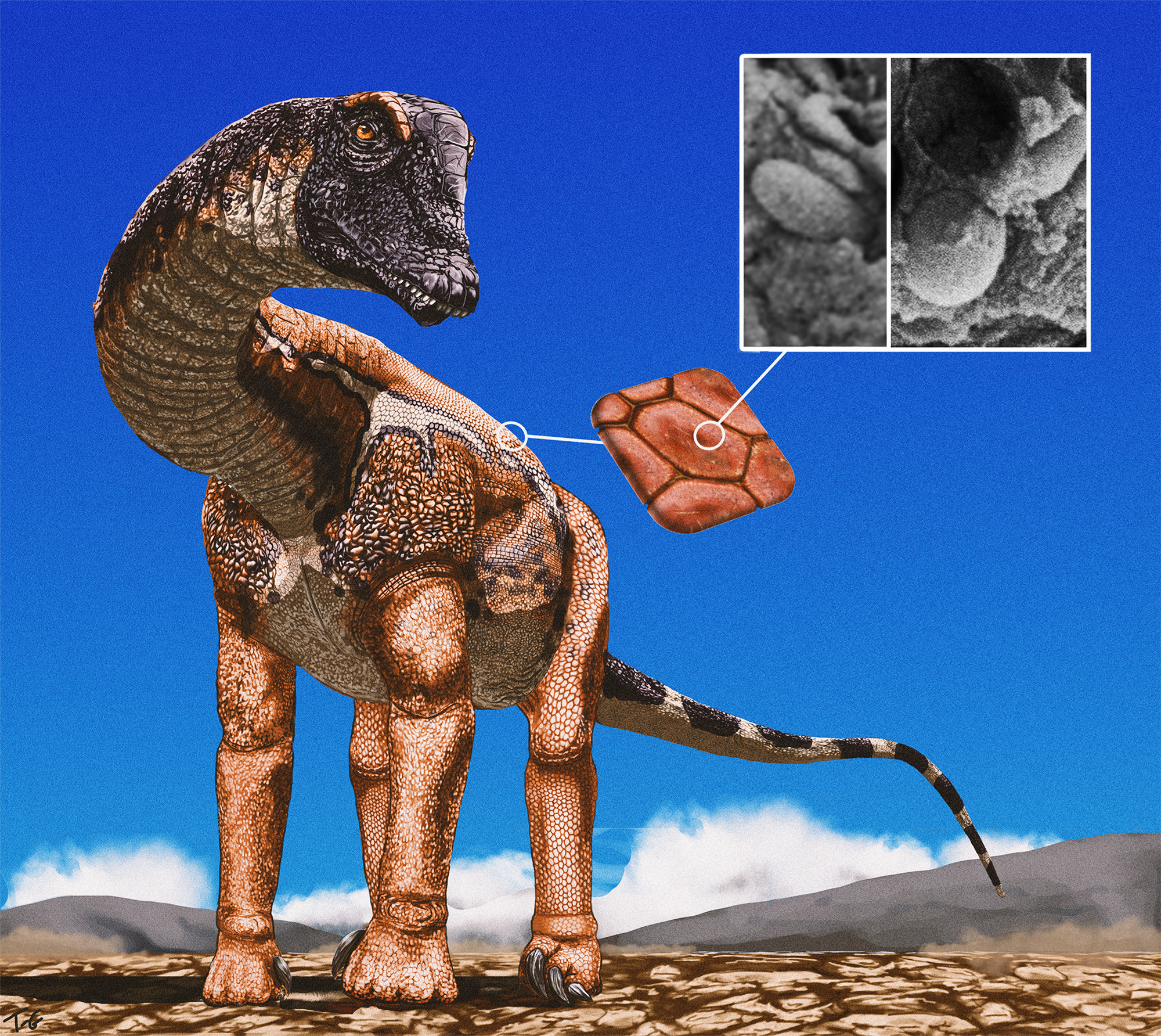
A small patch of sauropod skin suggests long-necked dinosaurs were surprisingly colorful. Art by Tess Gallagher.
This post originally appeared in Riley’s newsletter The Boneyard. To support independent science writing and get stories like this direct to your inbox, subscribe on Buttondown.
Do you remember drab dinosaurs?
The elephantine reptiles waddled and soaked in almost every dinosaur book I pulled from my elementary school’s libraries. The unhurried reptiles basked in an endless Mesozoic summer, great lumps draped in various shades of mud. I still see such throwbacks sometimes on the side of the road, the great green mascot of Sinclair Oil. And they’ve always seemed wrong.
I remember the logic behind it. Large mammals like elephants, rhinos, and hippos are drab - giraffes always conveniently left off this list of megafauna - and so large dinosaurs were probably plain, too. And what reason would dinosaurs of such size have to wear striking colors? To impress each other? Such experts must have thought of sauropod courtship and mating as one animate hill climbing onto another animate hill before moving off to eat more plants.
The argument for solid gray, brown, or green sauropod hides always felt flimsy to me. Of course no one had direct evidence to resolve the question, and so no one could really know for sure, but I figured that if you’re capable of growing so large that even the largest carnivores are unlikely to kill you, why not be flashy?*
Paleoart has increasingly experimented with the latter view in recent years, dinosaurs like Apatosaurus and Argentinosaurus decorated with all manner of stripes, spots, and colorful patterns ranging from garish to concealing. And yet, even as paleontologists found evidence in the feathers and scales of other dinosaurs, direct evidence of sauropod coloration remained out of sight. It’s challenging to find sauropod skin fossils in general, much less those preserved well enough for experts to find the tiny, rounded organelles - melanosomes - that contributed to the dinosaur’s coloration. How lucky are we, then, that paleontologist Tess Gallagher and colleagues have finally brought us the first glimmerings of sauropod shades.
Gallagher’s research began with a lucky find. While volunteering with Elevation Science Institute at excavations of Montana’s Jurassic Mother’s Day Quarry in 2019, Gallagher and her mother uncovered a patch of skin along a section of Diplodocus rib. “In all honesty, seeing it broke my brain,” Gallagher says. The pattern wasn’t anything like the wrinkly, uniform skin of paleoart sauropods. “What I saw instead,” Gallagher says, “was a remarkably textured animal, with scale patterns I never would have thought possible.”
The find led to Gallagher’s first paper, published two years later, that showed the little Diplodocus common to the quarry had skin marked by various scale shapes. The distribution of the tiny blobs looked similar to what’s seen in living reptiles, where scale shapes differ between adjacent body parts like abdomen and shoulder. But there was more. When Gallagher and colleagues looked at some of the quarry’s skin scraps under scanning electron microscopy, they found melanosomes that would have contributed to the dinosaur’s coloration.
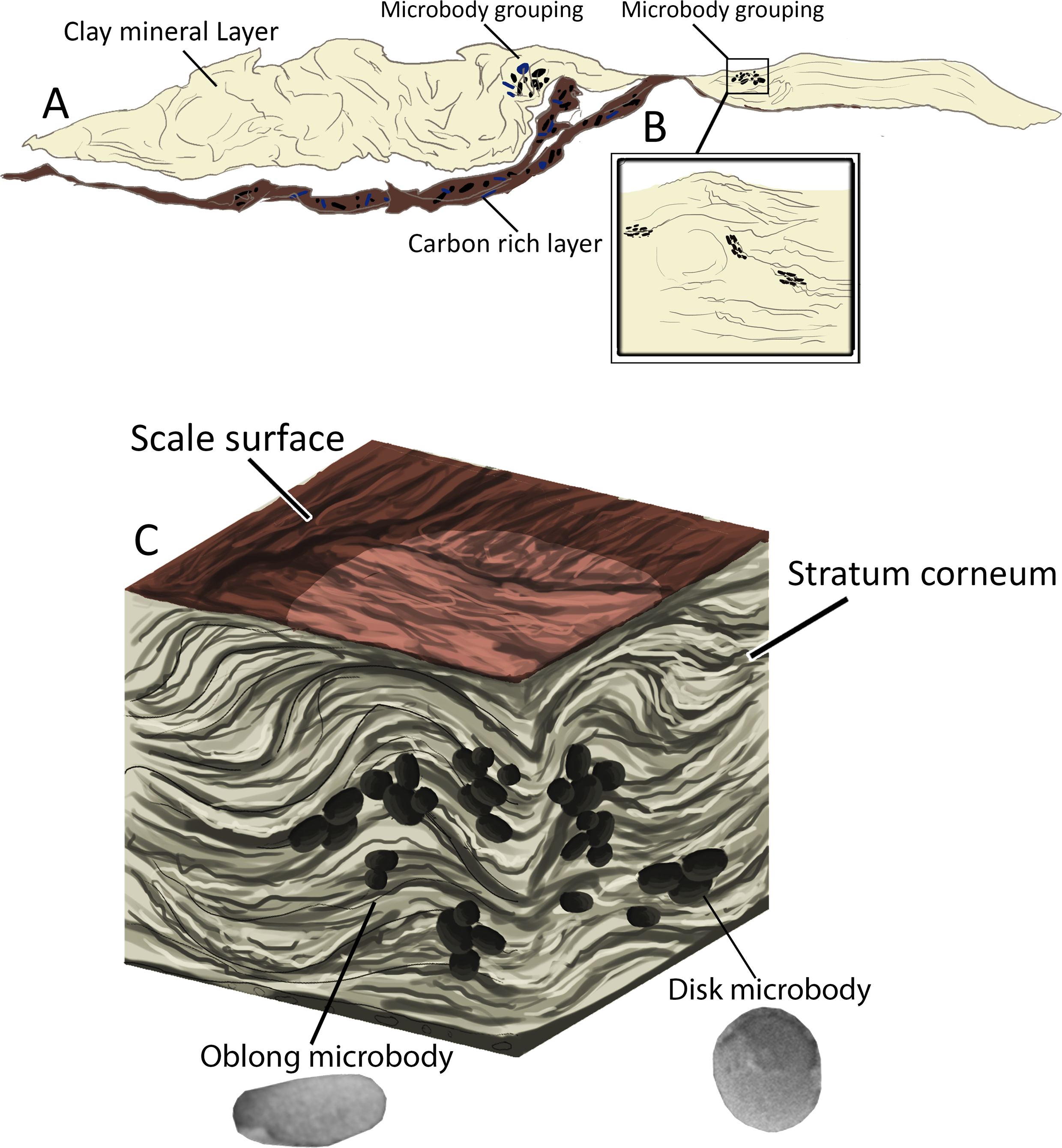
Artistic interpretation of Diplodocus skin, showing the placement of melanosomes within the reconstructed skin layers. From Gallagher et al. 2025.
The find does not deliver us a Diplodocus with vaporwave style or ornamented with electric green stripes. The fact that Gallagher and colleagues refrain from being definitive about the dinosaur’s color is one of the reasons I love the paper - the care to define what the evidence can show and what it can only hint at. What the find and resulting research demonstrates is that sauropods may have been highly-patterned, colorful animals, a possibility that should have experts treating any other sauropod skin fossils with great care.
The key evidence comes down to unusual, disk-like melanosomes found among the fossilized skin. “When I first found them, I was desperately trying to find something similar in the literature, either in the fossil record or modern animals,” Gallagher says. “You can imagine my surprise when the closest possible thing I could find to these disk shaped objects were the flat, platelet melanosomes found in modern, colorful feathers. It was certainly an ‘oh shit!’ moment.”
Such a detailed view has only recently become possible with new tech. Paleontologists have increasingly been developing new techniques to look at the microscopic, previously-invisible aspects of dinosaur fossils, perceiving the remains in exceptional detail. “We weren’t expecting to see the stratum corneum preserved!,” Gallagher says, referring to the layer of dead skin cells that lay over the rest of the skin. “It felt like I was staring at modern reptile skin.”
The small, snack-sized Diplodocus of the Mother’s Day Quarry had the potential to have bright colors or disruptive patterns. As much as I want to imagine the little dinosaurs as flamingo pink shapes moving through the sun-dappled undergrowth, perhaps like Vernal’s mascot Dinah, the disk shaped melanosomes probably had more to do with creating concealing, disruptive patterns than eye-popping color. We’ll need additional and more extensive melanosomes to really know, but there’s no contradiction in striking patterns and camouflage as various animals have stripes, spots, and other patterns that help break out their outlines and hide them in their habitats. After all, coloration was often a matter of survival for these ancient reptiles. When we know about dinosaur color, we can start uncovering more clues about their behavior and ecology.
What’s immediately clear, though, is that paleontologists should be looking for such structures more broadly - across species and time.
“The biggest impact of these structures,” Gallagher says, “is how it will force melanosome researchers to rethink melanosome evolution.” Until last year, paleontologists thought that only feathery maniraptoran dinosaurs like birds and their close relatives possessed a diversity of melanosome shapes in their body coverings. Perhaps birds even inherited their range of hues from close dinosaurian relatives that evolved the diversity of color-creating organelles during the Mesozoic, something unique to their lineage. But then paleontologists discovered multiple melanosome types in Mirasaura - a non-dinosaurian reptile with a flashy fin on its back - months before Gallagher and colleagues published their own study about diverse color-influencing organelles in Diplodocus. “The combination of Mirasara and our researcher on these disk melanosomes in Diplodocus both challenge these ideas on the evolution of diverse melanosome morphologies,” Gallagher says, suggesting a deeper evolutionary origin for varied color-producing melanosomes among reptiles. Reptiles of the deep past, even before the dinosaurs, may have been far more colorful than anyone expected.
But before I leave you to imagine your own spotted, striped, or otherwise striking sauropod, consider the nature of the Mother’s Day Quarry for a moment. The bonebed is rife with juvenile Diplodocus, young dinosaurs that perished long before reaching adult size. Just as dinosaur skeletons changed as the reptiles grew, perhaps their coloration did, as well. Did Diplodocus wear the same colors and patterns their whole lives? Or did they change as the reptiles aged, perhaps becoming even more lavish and arresting as the herbivores got too big for Allosaurus to fuss over? We’ve known about the inner skeletal workings of dinosaurs for a long time. Now we’re just beginning let our curiosity run skin deep.
*I suspect this was an unspoken part of the drab sauropod hypothesis - that bright or striking colors would attract the unwanted attention of carnivores like Allosaurus, whose destructive abilities were greatly overestimated by paleontologists who had yet to think deeply about dinosaur ecology. And while the “good reptile” framing could be argued to influence the 20th century color choices, too, this is a contradiction as even common lizards and snakes are quite colorful. If thinking of sauropods as drab was influenced by scientific stereotypes about reptiles at all, it’d just be proof that paleontologists knew as little about living reptiles as they did about dinosaurs.