The Mother of Spiders, Horseshoe Crabs, and Things That Go Snap
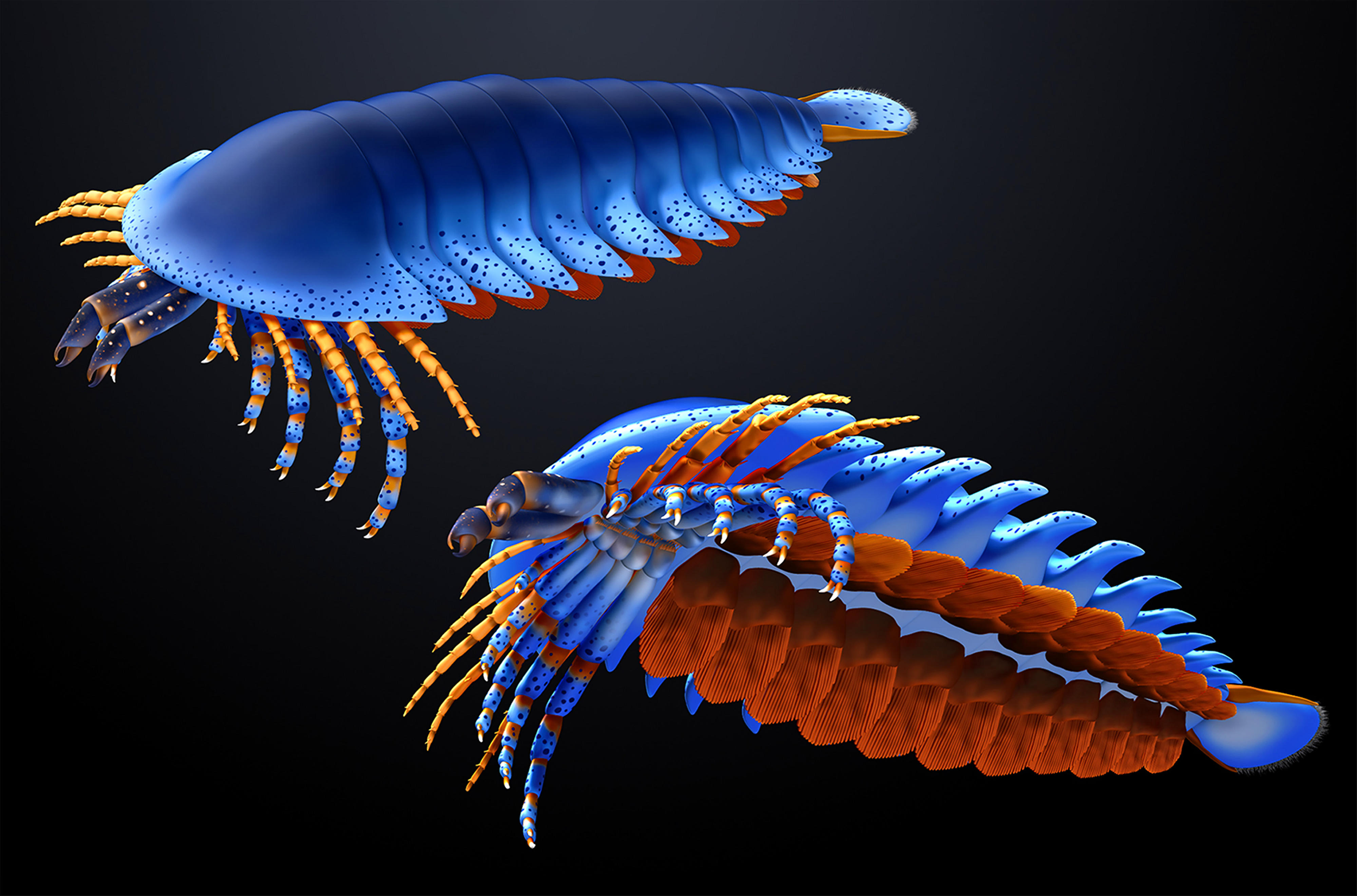
The claws of Megachelicerax give away its relationship to spiders, horseshoe crabs, and other chelicerates. Credit: Masato Hattori
This post originally appeared in Riley’s newsletter The Boneyard. To support independent science writing and get stories like this direct to your inbox, subscribe on Buttondown.
You’d think that the great Cambrian predecessor of spiders wouldn’t be that hard to find.
Chelicerates are everywhere today. Biologists have cataloged more than 120,000 species of them, from the jumping spider crawling on the kitchen wall to the horseshoe crabs that drag themselves to the tide line to spawn every spring to the tiny, tiny mites that live on us. And despite the fact that most chelicerates have always been small, the invertebrates - allied by the claws at the front of their mouths called chelicerae - have a pretty good fossil record spanning hundreds of millions of years.
Up until now, the oldest known chelicerates were found in rocks about 420 million years old. The fossil arthropods looked like horseshoe crabs, and some were found among animals that were thought to have gone extinct at the end of the Cambrian. Perhaps chelicerates split off from other arthropods during the Cambrian, too, a likely scenario given how many modern invertebrate lineages have been drawn back to the wonderfully weird era of the Burgess Shale. The fossils necessary to test the hypothesis, however, proved elusive. Maybe Cambrian chelicerate fossils just hadn’t been found yet. Or maybe evolution played out in a different way than experts thought.
But now, it gives me great pleasure to say, the missing Cambrian chelicerate has been found. Meet Megachelicerax cousteaui, the “big claw.”
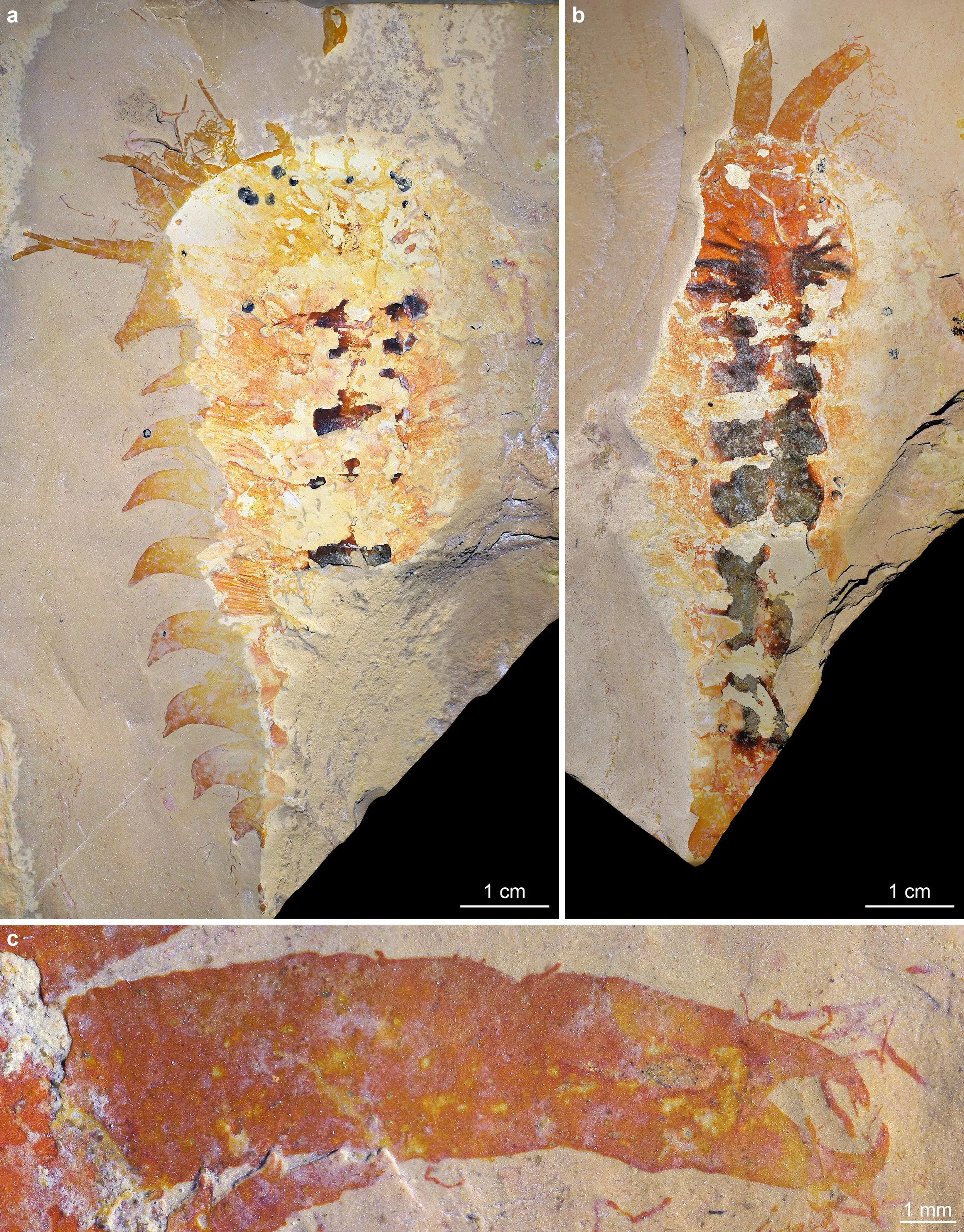
Views of fossil Megachelicerax, the bottom image showing the telltale claw. Credit: Rudy Lerosey-Aubril
The long-sought fossils were found among Utah’s House Range in rocks more than 500 million years old. Had the fossil been less complete, it might have been announced as a possible relative of early chelicerates based upon the details of its exoskeleton. But, as paleontologists Rudy Lerosey-Aubril and Javier Ortega-Hernández write, “Megachelicerax gen. nov. is confidently assigned to Chelicerata owing to the unequivocal synapomorphic presence of chelicerae.” Megachelicerax possesses the defining, unifying feature of the group, now the oldest relative of spiders and scorpions known.
Of course, Megachelicerax doesn’t just share features in common with members of its own group. The new study, published today in Nature, proposes that the new fossil invertebrate shares features in common with a strange group of invertebrates called megacheirans. Think of a mobile lobster tail with branch-like appendages sticking out of the front and you get the idea. Even though the nature and relationships of megacheirans are not totally worked out - it may be that it’s an artificial grouping of many invertebrate types instead of a natural family - the shared features still hint that the ancestors of the first chelicerates came from such animals.
It’s funny to see the story of Cambrian shift as it comes into closer focus. I fondly remember reading Gould’s Wonderful Life, still an epic treatment of the time period, when it seemed that many Cambrian creatures represented bizarre offshoots that embodied an unrealized evolutionary alternative to life as we know it. In the decades since, many Cambrian creatures previously considered inscrutable oddballs have been found to be early members and relatives of animal groups that are still here. More than that, there was no major extinction at the end of the Cambrian. Body plans and disparate forms previously thought to have been surpassed by more modern oceanic creatures didn’t disappear at the end of the Cambrian, after all. They survived for tens of millions of years more, living alongside and helping give rise to long-lived lineages that still prosper to this day. The story is one of connection and continuity over more than 500 million years, such that I can look at Megachelicerax and recognize the beginnings of the wolf spider I see dart over the sidewalk as I pass by.
Sadly, I can’t see Megachelicerax scamper around. So far as they can reconstruct based on the invertebrate’s anatomy, Lerosey-Aubril and Ortega-Hernández propose that the dawn chelicerate was a four inch-long predator that swam near the bottom, picking at smaller prey with its segmented claws. It wasn’t the only invertebrate to do so. Utah’s Wheeler Formation, where Megachelicerax was found, is full of other exoskeletal hunters that grabbed and pinched at smaller creatures. The claws of Megachelicerax didn’t set off a big evolutionary burst for chelicerates, perhaps because the ancient seas were already replete with similar organisms.
But when chelicerates began to emerge onto land, the scorpions and ancestors of spiders and eurypterids that could drag themselves overland, the snipping chelicerae met a world of possibility. Variations in chelicerae opened different evolutionary possibilities, an integral part of what drove the diversity of the group. More than 15 million years passed between Megachelicerax and a burst of land-dwelling chelicerates that would set the foundation for the tens of thousands of chelicerate species that live among us today. When the moment came, the claws were ready.