The Gorgon Bird
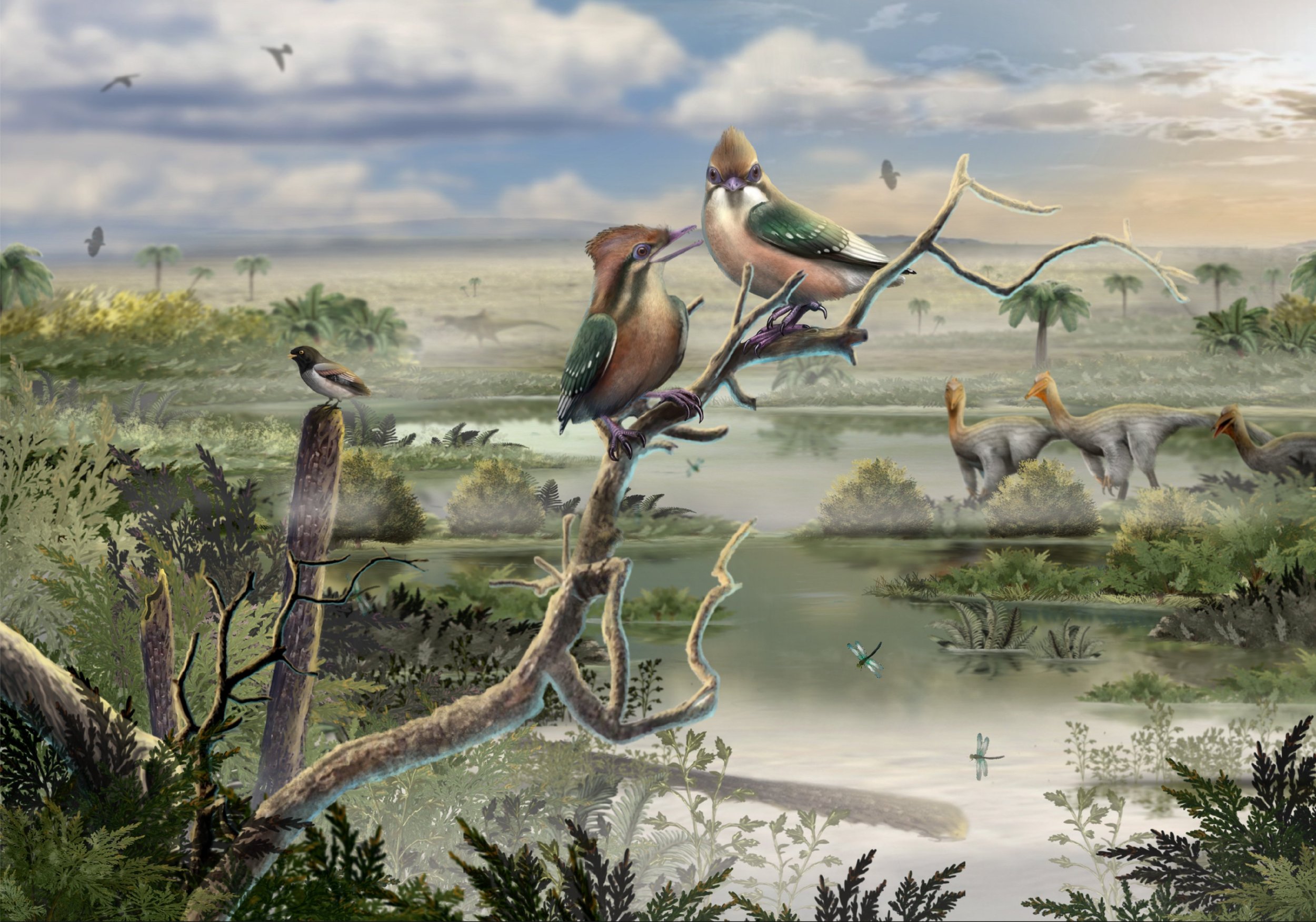
The toothed bird Gorgonavis socializing in Early Cretaceous Spain. Art by Roc Olivé.
This post originally appeared in Riley’s newsletter The Boneyard. To support independent science writing and get stories like this direct to your inbox, subscribe on Buttondown.
Birds used to have teeth. Many of them, at least. From Archaeopteryx awkwardly fluttering around Jurassic lagoons to the little insect-eaters zooming through Maastrichtian forests just before the big asteroid strike, toothy birds thrived alongside their dinosaurian kin for tens of millions of years. Then they were gone. Their current absence always makes me look at the crows, jays, and robins around my neighborhood curiously - what would it be like if morning light glinted off of avian teeth?
Only beaked birds survived the end-Cretaceous catastrophe. The toothless omnivores were already well-suited to plucking morsels out of the seed bank, food kept safe from the fire and able to wait through the impact winter. Being able to make use of this food, which may have been indigestible to the more carnivorous toothed birds, made the difference. Beaked birds hung on and kicked off a new evolutionary burst that continues to this day, while the toothed birds vanished with all the non-avian dinosaurs. The best information we’ll get about toothed birds, then, comes from the fossil record itself - like a gorgeous skull found in the Early Cretaceous rocks of Spain.
The fossil, described by Johns Hopkins University paleontologist Sergio Nebreda and collegues, was found among the roughly 125 million-year-old rocks of Las Hoyas. The fossils found there are exceptionally-preserved, Nebreda says, but “due to the nature of the limestone matrix, many of the remains require preparation or micro CT-scans in order to be fully observed.” The great care also requires time, and, with far fewer paleontologists than fossils, it can take a while for important finds to get their time in the spotlight. In the case of Gorgonavis, the moment came in 2022.
In that year, Nebreda and colleagues were looking through the collections of Spain’s Paleontological Museum of Castilla-La Mancha, close to the Las Hoyas fossil beds. The museum’s collection included unidentified fossils held together in a box. One of the pieces inside was some sort of fossil encased in resin, a method that protects fragile fossils while still allowing light to pass through. “When I lifted it up and looked at it against the light, I saw what was clearly a break,” Nebreda says, and so the researchers immediately made arrangements to CT scan the fossil to get a better look. The long-snouted bird was something new, and earlier this year was named Gorgonavis alcyone.
In the broader bird family tree, Gorgonavis is perched among the widespread and varied enantiornithines. (While there were other forms of toothed birds, such as the loon-like Hesperornis, the enantiornithines small flyers most comparable to many of the songbirds we see around us today.) Even more precisely, Nebreda and colleagues found, Gorgonavis was related to long-snouted toothed birds like Longipteryx found in China’s fossil beds. “What makes it peculiar is that Gorgonavis is the first species of this family described outside China,” Nebreda says, indicating that such snouty birds may turn up at other Early Cretaceous fossil sites in Europe and Asia.
And while a single skull might not seem like much by itself, it truly is a special find. “Gorgonavis represents the first cranial remains of an adult birds found at the Las Hoyas site,” Nebreda says. Most of the bird fossils found at the site are headless. In fact, the researchers double-checked to make sure the skull didn’t belong to a bird that had already been named, like Concornis or Eoalulavis. But even when experts only have a part of a fossil skeleton, that skeleton may exhibit telltale traits the go together with other characteristics elsewhere in the skeleton. This is because - forgive me for employing this overused term - organisms are mosaics, carrying along subtle traits that mark them as distinct from other species or lineages. The placement of a foramina or the extent of a bony ridge on a limb bone can be incredibly informative in identifying who’s more closely related to whom. In this case, the known Las Hoyas birds didn’t possess any traits that suggested they might be close relatives of Longipteryx, while the fossil skull did, and so the experts are confident that Gorgonavis is distinct from the other birds found in the same rock layers.
I wonder what the toothy, long-snouted fliers looked like when alive. Without feathers, or the rest of the body, it’s difficult to tell. I even asked Nebreda if the long snout indicated anything about diet or ecology, but the multipurpose nature of bird mouthparts - whether beaked or toothy - makes it difficult to tie a particular form to a narrow function. We’ll likely have to wait for gut contents, geochemical analysis of the bird’s teeth, or some other clue to know more.
Still, as I listen to the local birds peep and chirp out my window as I write this, I can’t help but wonder if any of them are living a life that’s an echo of what Gorgonavis did way back when. The ancient bird seems both familiar and wholly unusual, like a modern bird in costume. And yet they came before, so long before, during a time when long-necked dinosaurs browsed on ginkgoes dotting the floodplains and there were much larger faunivores with both feathers and teeth. I can’t see them live. So I’ll have to keep imagining.