The Pretty Kitty in the Cabinet
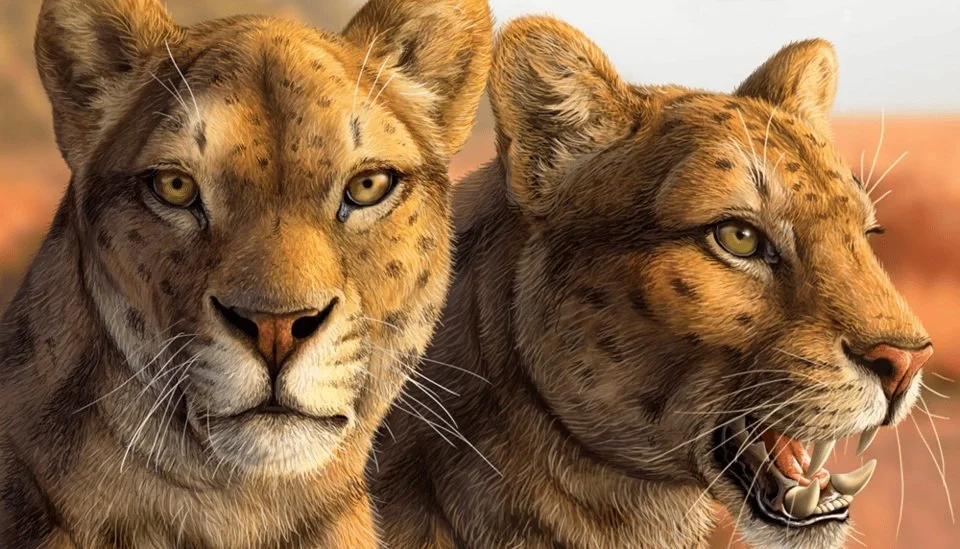
Adelphailurus kansensis, a cougar-like sabercat. Art by Jesús Gamarra.
This post originally appeared in Riley’s newsletter The Boneyard. To support independent science writing and get stories like this direct to your inbox, subscribe on Buttondown.
The morning is already hot. A few puffy clouds tease the woodland from off to the east, lazily-floating water that may or may not pass by later to turn the air cool and sticky. A cat can’t count on such uncertainties. Rump nudged against the dusty roots of a jagged-leafed hackberry, the carnivoran sits and pants, watching a pair of bulky camels rip gritty clods of grass under the stark midday light. Too big to easily catch, no cover, and just too hot, kitty sighs in time with the breeze that rustles her shade.
In the dark, she could make a play at one of those elegant necks. She is near soundless in the night, the grass on open ground just tall enough to hide the movement of her shoulders and the little flicks of her tail. Grab, bite, and follow the coppery scent of the splatter, tried and true. But not in the daylight. The shift and rustle of grass would give her away before she even got close enough to pounce.
Predators like her have been around for tens of millions of years. Since the time when these lands were covered in dripping forests. When her ancestors were lithe, weasel-like things squeaking and leaping between branches. Other carnivores got to the role of sabertooth first. But now, among these Miocene plains, she’s taken up the occupation. Despite her round, domed feline head, making her look almost modern, her teeth are blades - compressed from side to side and serrated near the base. If she tried to clamp down on the nose of one of those camels, or squeeze their slender throats between her teeth, she’d risk a debilitating fracture. Knives must be cared for. They require precision. And precision is what she’s evolved to deliver, a cutting, shearing bite through trachea, nerves, blood vessels, turning the size of the megaherbivores against them. They have big guts, vast patches of vulnerable, gently-pulsing softness. Her bite rends tenderness to tatters.
Something behind her. The cat’s ears flick back, as if she’s just been hissed at. But she’s listening. A subtle squeak. Scratching. Rodent. A deer mouse, snuffling around the roots of the tree for seeds and other offerings of the tree’s generosity. The sabercat can hardly contain herself, paws that were at rest a moment ago now as gently tense as a tuned instrument. Mice are quick. If she wheels around now, no doubt the rodent will be down its hole or back into the grass before she even has a chance. She waits. She tries not to shimmy and she waits.
A broad paw slaps dust off the ground as the cat lunges for the mouse. The particles aren’t even settled back to the ground before she sees a subtle rustle in the waxy threads of grass just outside the tree’s shade. Missed. She snuffles the spot, licking her nose even though she caught nothing to taste, and she groans as she sits back to scratch behind her ear - releasing all of that stored anticipation some place to empty itself so that she may rest again. Maybe later. Maybe tonight. A few more cottony patches are gathering in the west. Best to sleep, and perhaps dream what the cool of the night will offer her.
The skull wasn’t supposed to belong to a sabercat. Stored in the American Museum of Natural History, among various felid fossils gathered from North America during a time when prehistoric beasts were of greater interest than dinosaurs, the near-complete cranium was thought to belong to Pseudaelurus - a Miocene cat more closely related to the ancestors of lions, leopards, and jaguars than to sabertooths like Smilodon.
But Pseudaelurus is a wastebasket. This is what paleontologists call a taxon where various fossils are attributed to it without full examination, when enough rough guesses pile up that a single name ends up standing in for hidden biodiversity. So when paleontologist Narimane Chatar set about studying sabertoothed cats, including a form found in ancient Kansas called Adelphailurus kansensis, the AMNH skull sprung back to mind. The fossil wasn’t from a relative of tigers. It was a stunning, unrecognized example of Adelphailurus.
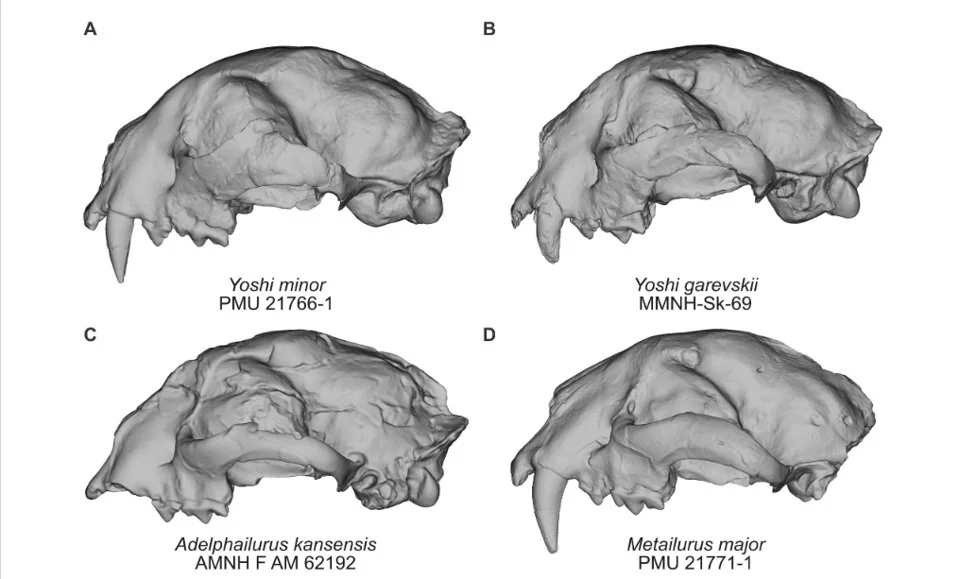
Left side views of 3D models of Yoshi, Metailurus, and Adelphailurus skulls. From Chatar and Tseng, 2026.
The newly-recategorized skull, described by Chatar and Z. Jack Tseng, reveals a sabercat quite different from our standard image. The great, LA-famous Smilodon is the most iconic sabercat of all, as well as one of the last. Earlier forms were not quite so specialized, and, as Chatar and Tseng point out, sabertooth skull shapes evolved into a wider variety of shapes than experts used to believe. Not all were narrow-faced predators with truly extreme dentital cutlery. At around 5 million years old, found at fossil sites from Kansas and Arizona down to Guanajuato, Mexico, Adelphailurus superficially resembles the lineage leading to our modern big cats. The cat was a sabertooth with shorter, but still knife-like canines and a more rounded, domed head, clustering closer to other sabercats like Yoshi and the classic Dinofelis.
Perhaps Adelphailurus represents the early days of sabertoothed adaptations among cats. The megafauna-munching specializations of the Ice Age Homotherium and Smilodon had to get their beginnings somewhere. But Adelphailurus is not a one-off, either. Other, similarly-shaped sabercats persisted until about 2 million years ago, just about the time the earliest Smilodon were stepping onto the scene. Perhaps such cats had some specific technique, prey preference, or other interaction with the ancient world that favored anatomy halfway between Panthera and extreme sabercat.
More cats may help answer the question. The AMNH Adelphailurus skull is hardly the only fossil historically labeled “Pseudaelurus” that may be something else entirely. Perhaps there are other sabercats already resting in collections, awaiting someone like Chatar to see them for what they are.