Legs Evolved Before Amphibian Metamorphosis
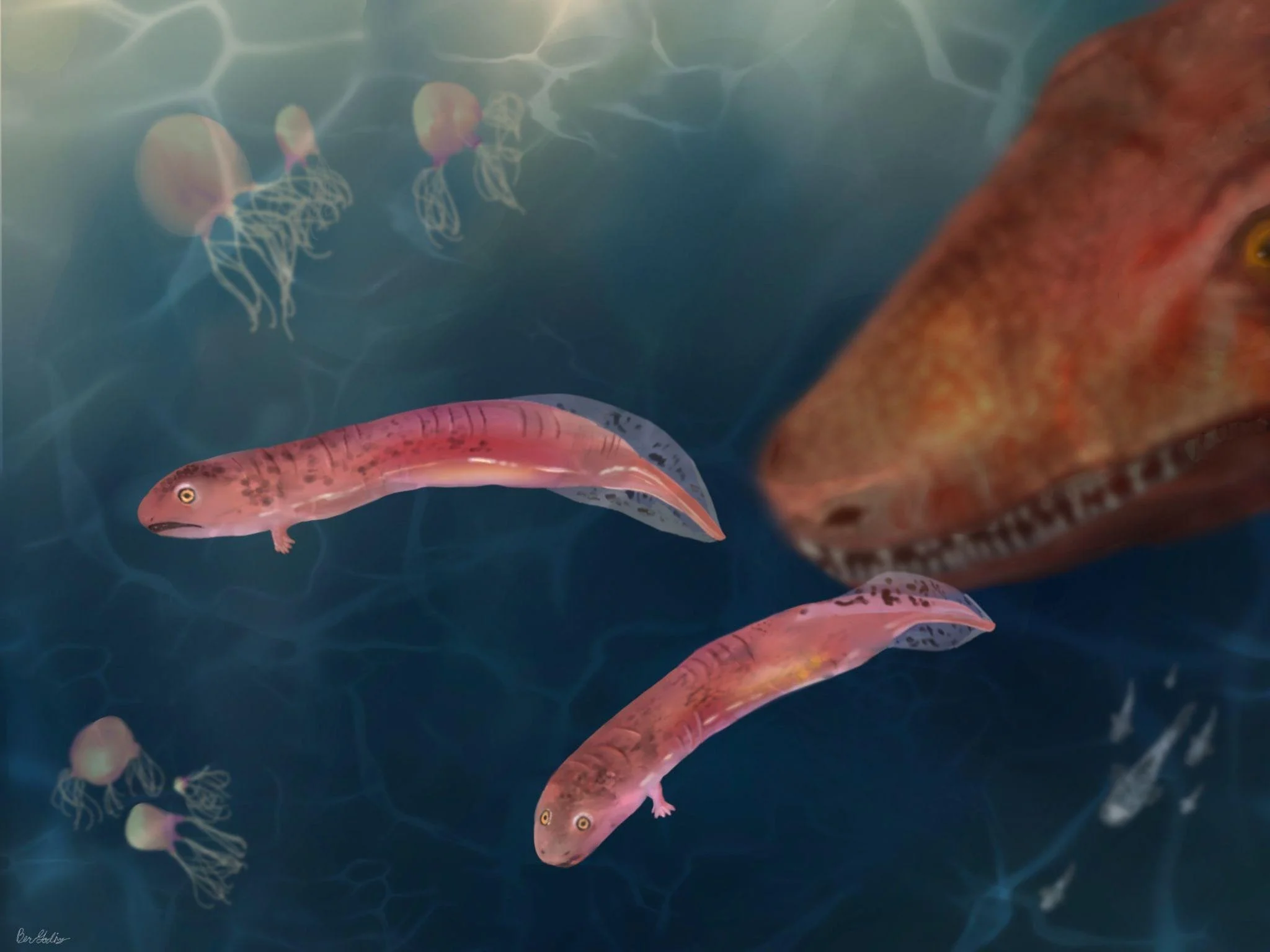
Babies of the earliest four-legged animals did not undergo metamorphosis and were more like mini-adults. Art: Berit Goding
This post originally appeared in Riley’s newsletter The Boneyard. To support independent science writing and get stories like this direct to your inbox, subscribe on Buttondown.
Wiggle
W i g g l e
The little fingers, the little legs, they’re not doing anything yet. Just little piggies, spread to the water.
The tiny wormles don’t have much to do other than wait in the busy waters, find someplace quiet. Someplace lacking teeth.
The yellow glop will sustain them for now, long enough for bone to weave its way through the cartilage base, long enough for tightly-packed teeth to grow larger, longer, ready to snap up little morsels
just like them.
But nothing comes by to grab or slurp or chomp, not on this morning. The little ones are free to twitch and shimmy like the sunshine, waiting, surviving, for another day to get closer
to the smooth-skinned, grinning shadow
that will make babies just like these.
Evolutionary science loves stories. Perhaps none is so cherished as how our fishy ancestors began dragging their bodies over land. Too often called “colonization” or “invasion,” there was no intent behind the move. Creatures bound to water began pushing the boundaries of their anatomy and physiology to explore the world beyond the water, and amphibian metamorphosis was supposed to be an important part of the process.
The transformation never ceases to amaze, even in the most mundane settings like a bull frog in a park pond. Today, in the 21st century, the fertilized jelly of frog eggs develop into tadpoles, distortions of fish that twitch and suck in the shallows. These early phases of amphibian life often possess external, feather duster gills, legs developing little by little as the creatures become more and more terrestrial. Perhaps, paleontologists speculated, the our earliest amphibious predecessors grew up like this, too. Limbs and fingers evolved in water first, so perhaps developmental changes in the swamps allowed the earliest tetrapods to crawl beyond them. Early tetrapods pushed themselves through weed-choked bogs, climbing out on land as long as they could stay wet, and appropriately-metamorphosed babies could have ventured further onto land to kick off a new burst of vertebrate evolution.
We have to throw that story in the recycle bin.
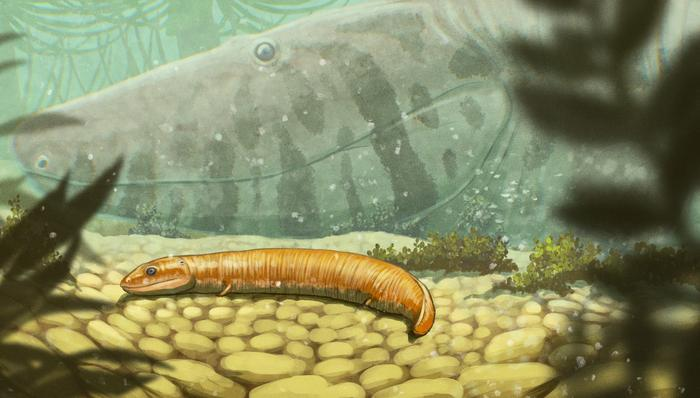
Another rendition of the baby embolomere with a speculative illustration of the adult. Credit: Gabriel Ugueto
Among early tetrapods, paleontologists Jason Pardo and Arjun Mann report, babies were closer to miniature versions of adult animals than tadpoles. In fact, the famous tadpole-led metamorphosis so commonly seen in modern amphibians is a specialized trait that likely arose in parallel between the ancestors of today’s amphibians, the temnospondyls, and another group called discosauriscids.
The stunning evidence comes from the exquisite fossil trove of Mazon Creek, Illinois. More than 308 million years ago, the area was humid swampland where freshwater and marine creatures mingled in various proportions as water conditions shifted over time. The nature of this place was so unusual that many soft-bodied fossils became encased in concretions of siderate, the mineral accumulating around the biological mass inside, including juvenile forms of some of the habitat’s fish and amphibians. Among them are larvae of embolomeres, ancient tetrapods that were alligator-like predators with many pointy teeth. The babies don’t look like tadpoles. They’re closer to adult embolomeres, the little ones possessing limbs but still developing their skeletons to move them, yolk sacs providing their nutrition for their earliest free-swimming days.
Pardo and Mann went further than simply describing the exceptional fossils. The experts identified larvae from fish related to early tetrapods, as well as other early tetrapod species, in their sample. Neither early tetrapods nor stand-ins for their ancestors showed evidence of metamorphosis or tadpole-like life stages. Metamorphosis did not allow amphibious tetrapods to spread onto land. Instead, the astounding transformations were more likely a consequence of earlier phases of becoming more terrestrial, a change that gave the ancestors of today’s amphibians an unexpected advantage while many other forms were more closely bound to the water.
For tens of millions of years after Tiktaalik, Pardo and Mann note, tetrapods were probably restricted to the watery environments they were born in. The presence of digits and limbs among these creatures does not inherently mean they were spending more time on land and away from the water. The appendages were aquatic adaptations first, allowing other parts of early tetrapod natural history to shift in the jaws and spine that were equally-critical prerequisites for moving around on land more often. The whole process is far more complex than previously thought, not only compared to the long-discarded “drying pond” hypotheses but also the triumphant new narratives that Tiktaalik dragged our lineage out of the water. No, if the little wigglers are any indication, many early tetrapods remained in the pool.