Bite of the Thresher
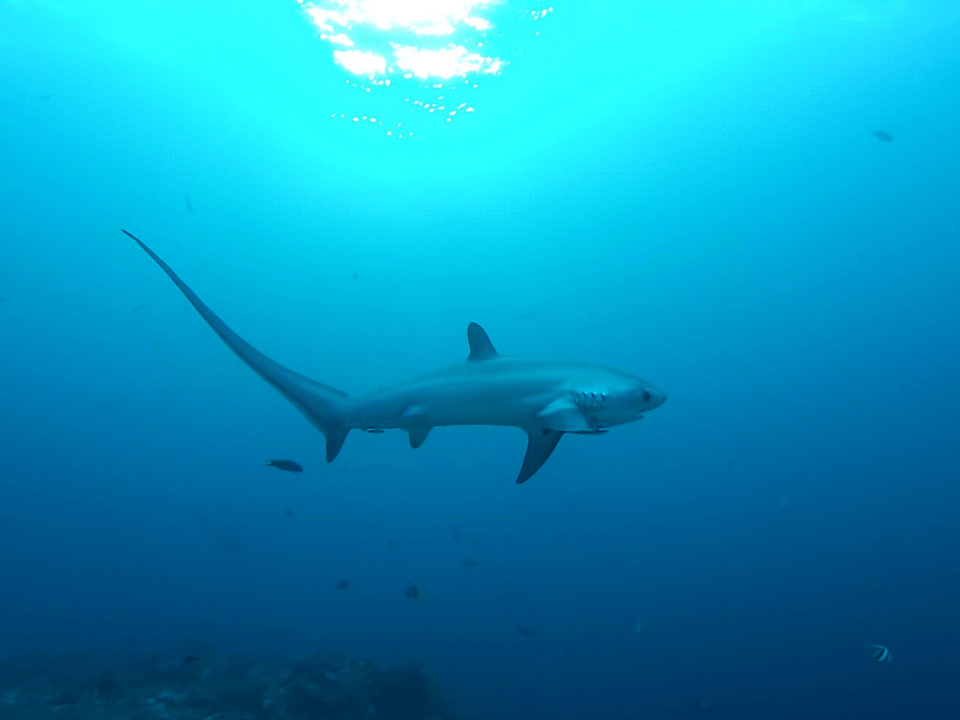
A modern Alopias, or thresher shark. Prehistoric forms likely lacked the elongated, stunning tail. Credit: Thomas Alexander CC BY-SA 4.0
This post originally appeared in Riley’s newsletter The Boneyard. To support independent science writing and get stories like this direct to your inbox, subscribe on Buttondown.
The rot must be nearby. The sticky traces of it are seemingly everywhere, loud in the water flowing through the shark’s nasal passages. She flicks her tail and clenches her body towards her left side, a shimmy into a quick left turn to sniff out the body in the dark.
She’s not even that far down. Hints of something blubbery decaying along the coastal shelf had drawn her in from the more expansive waters off the ancient Maryland coast. But 600 feet down, at the border of where sunlight would already weaken even on the brightest days, a moonless night has led her to ignore the little flashes and sparkles of bioluminescence as she’s followed her nose.
If the Joker-grinning dolphin had been alive, or, even better, in its death throes, the shark would’ve had something to key in on. A bioelectric crackle to tingle the pores in her nose, pressure against her sensitive lateral line. But the Squalodon had been laying on the bottom for three days already, several large mouthfuls scooped out by other sharks as smaller scavengers have continued the deconstruction project piece by piece. The potential meal waits in the dark, the smell of its putrefaction giving its presence away to the plump thresher.
The tip of the shark’s broad right pectoral brushes the bottom for a moment. She tilts up, just slightly, as she cruises. The scent’s getting a little stronger now, the cloud beginning the overwhelm the other scent cues at this depth. There. She can feel the movement of little fish scatter, pushing water against the prone body that create just enough disturbance in the water to feel what’s there - the outline of something large, and soft. Unseen, and seeing nothing herself, the rubber bands suspending her jaws spring and throw her edged bite into the blubber, easily cutting in. But few sharks are so sharp as to take an entire plug of flesh in a bite. She holds and exaggerates the same motion she uses to swim, a thrash to the left and right and left and right again as her mouthful pulls away.
She will be among the last of her lineage to feed this way. The sheer abundance of marine mammals, fatty dolphins and whales and seals and dugongs, has underwritten the evolution of an array of sharks with serrated teeth suited to cutting more than gripping. Even the fish-eating, smooth-toothed makos are spinning off a new, bulkier iteration with a penchant for coastal seals and equipped to handle them with coarsely-serrated teeth. At this moment, in the Miocene seas, there is plenty of food for a mammal-munching thresher. But as seas cool and shift, favored prey changing with the temperatures and sea level shifts, there will be fewer blubbery snacks for such sharks. The threshers will find their place in deeper waters, slapping at silvery little fish and sparkling squid with elongated tails. Saw teeth will no longer be required. Thresher teeth will be smooth, gripping tongs rather than saws.
Mercifully for our thresher, though, she has no concerns of such distant evolutionary futures. For now, there is food and her stomach is still feeling vacant. She pulls the long upper lobe of her tail through the water again as she arcs back to the recumbent whale, both host and delicacy at the meal. The shark bites again, and with a shake, and a saw, is a little less hungry.
Some thresher sharks didn’t act like the big-eyed, slap-tail forms we know today. Miocene teeth, all we really know of the fish, indicate that some ancient threshers lived like modern great white sharks.
At the 2015 Society of Vertebrate Paleontology meeting, paleontologists David John Ward and Bretton Kent presented a poster on a new, ancient, shark. For years there had been rumors of strange, giant thresher shark teeth found by and circulated among private fossil collectors. No such species had been formally described. Working with one such dealer, the researchers obtained one of the serrated mystery teeth and set out to find more - locating at least one in situ tooth among the Calvert Cliffs of Maryland. The giant thresher was real. Kent and Ward gave it a name in 2018, Alopias palatasi after fossil collector Mark Palatas who donated the first specimen.
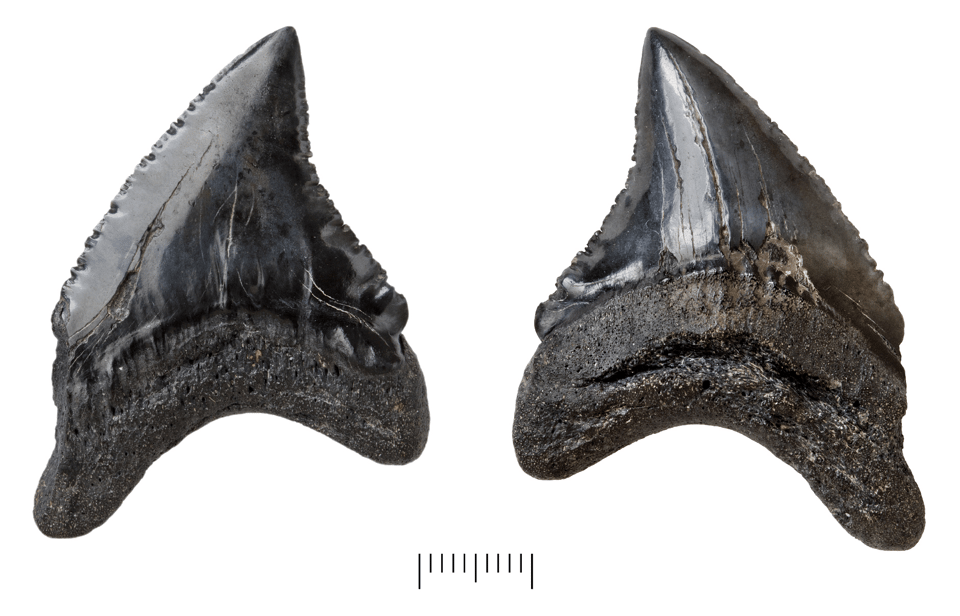
Tooth of A. palatasi, showing serrations. Credit: NHM Collections CC BY-SA 4.0
The teeth of A. palatasi have the same outline as other thresher shark teeth. They’re broad across the bottom and have somewhat of a bent A-shape (though not as extreme as among tiger sharks). What sets A. palatasi apart from more easily-recognized thresher teeth are the serrations. Threshers had long been thought of as a fish-eating lineage, with smooth-sided teeth best suited to puncturing and holding slippery prey. Serrations go along with larger prey, sawing behavior to cut out chunks of large prey items just as great white sharks do. At the very same time as great white ancestors were making the switch from a diet heavier in fish to one that incorporated more marine mammals, picking up serrations, it seems some thresher sharks did the same thing.
A. palatasi is not the only giant thresher. The smooth-toothed A. grandis has been known to paleontologists since 1942. It’s difficult to know why these similarly-sized sharks, comparable to the largest predatory sharks today, had such different teeth. Perhaps it was a matter of niche partitioning, the A. grandis line going after fast-swimming fish like tuna and A. palatasi becoming more specialized on marine mammals (a coupling that made the mammal-eating threshers vulnerable when the abundance of smaller-size sea beasts vanished around the end of the Miocene). Both were apparently larger than modern threshers, and likely had different proportions, which only raises the mystery of how modern Alopias species evolved their distinctive whip tails. Could they be descendants of A. grandis? Or maybe, impressively, they are the offspring of A. palatasi that began to shift food sources and swim deeper - a natural experiment of the “maybe megalodon is still somewhere in the deep” that people just love to entertain. We may never know. The answer will not be in the teeth. But we get the outline, sure as the punctures of a shark bite.