The Lizard in the River
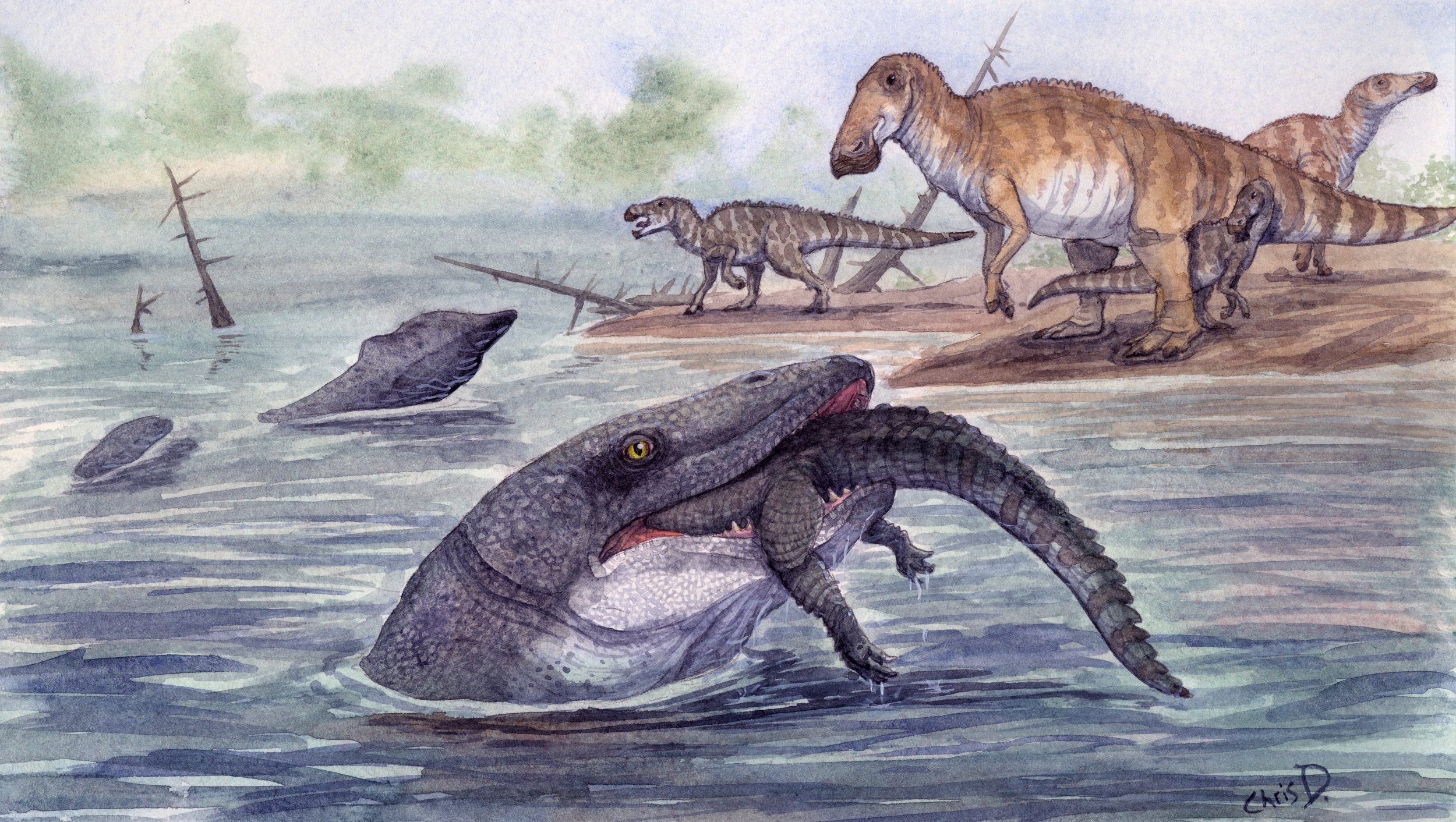
Mosasaurs venturing into freshwater would have found abundant food. Credit: Christopher DiPiazza
This post originally appeared in Riley’s newsletter The Boneyard. To support independent science writing and get stories like this direct to your inbox, subscribe on Buttondown.
The whale didn’t make it back out to sea. Earlier this week a young grey whale perished in Washington’s Willipa River, one in an unexpected and tragic series of cetacean deaths among the state’s waterways. It’s impossible to remove the whale. The beast will decay there, a “marine mammal” whose bones may be buried in silt and sediment carried by freshwater.
A million, ten million, or a hundred million years from now, I wonder what someone might think of the whale’s bones. How would they recognize it? Would the whale’s bones just be strange remains? Or would it be shocking, the skeleton of a seagoing animal perhaps surrounded by fossils of leaves, trees, bony fish, deer, and raccoon remains? I wonder because paleontologists recently asked very similar questions about a tooth that appeared where no one was expecting it.
For the moment, the specific designation of the tooth’s owner is unknown. Found in 2022, among the Late Cretaceous rock of the Hell Creek Formation in North Dakota, the tooth belonged to a very large mosasaur. The size and anatomy of the point suggest that the mosasaur was part of a group called the prognathodontini, large aquatic lizards closely related to the immense Mosasaurus itself. Based on comparisons to other mosasaur teeth and the size of their owners, the North Dakota reptile was likely more than 30 feet in length. As long as the adult T. rex that it swam by as the reptile slid through Cretaceous rivers.
Reported in BMC Zoology late last year by paleontologists Melanie During, Clint Boyd, and colleagues, the tooth was found in a freshwater deposit that also contained a Tyrannosaurus tooth, the jaw of the crocodile Brachychampsa, and bones from the shovel-beaked dinosaur Edmontosaurus. The mosasaur had shed a tooth in the river - perhaps while feeding or maybe because that tooth’s time to be pushed out had come - and kept swimming along.
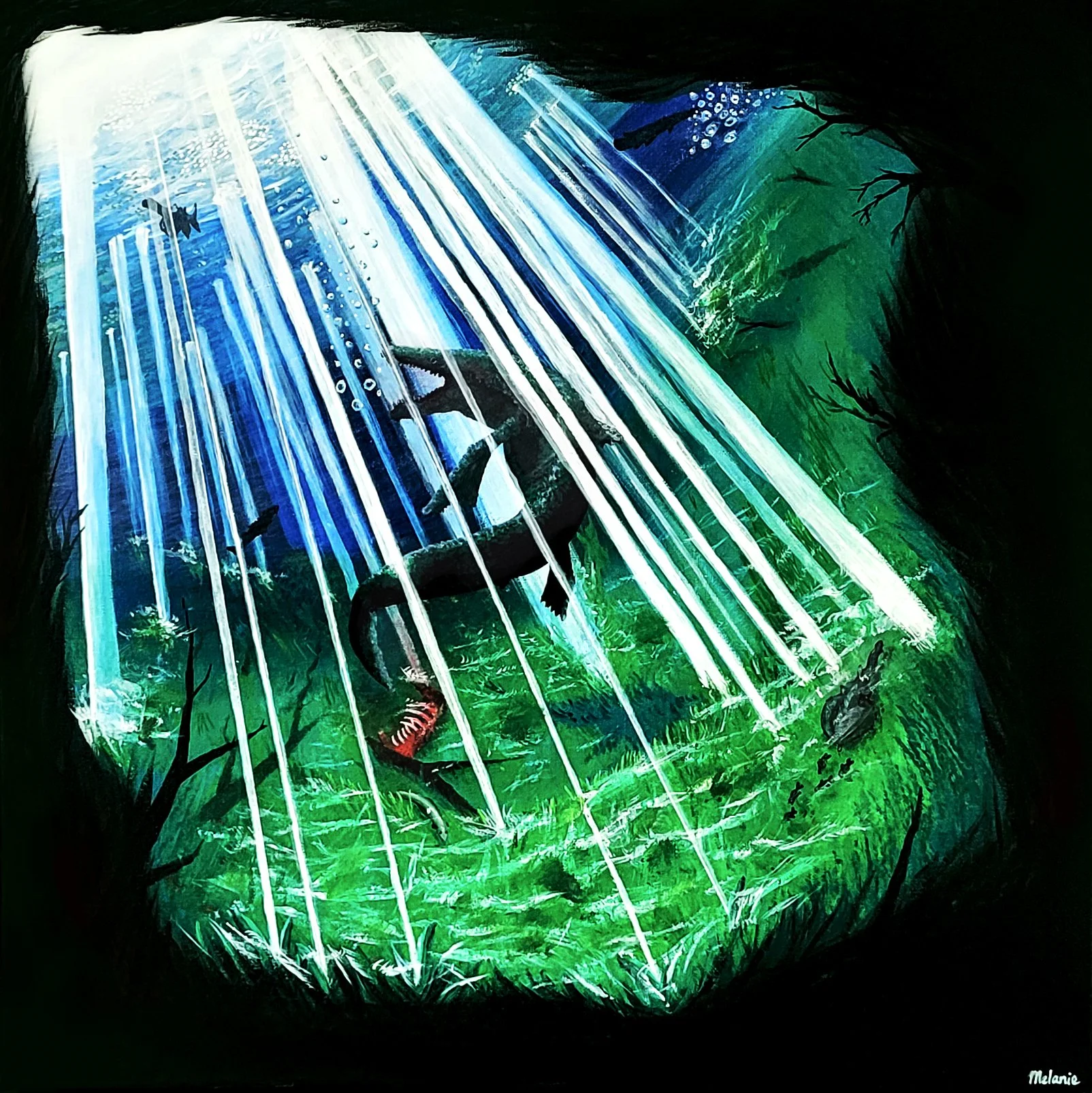
A mosasaur swims through a Cretaceous river in ancient North Dakota. Credit: Melanie During
Mosasaur fossils have been found in rocks deposited in brackish habitats before, as well as mosasaurs that have been interpreted as being just the right shape to navigate the more constrained environments of rivers and lakes. Most of these fossils represent animals that were about 15 feet long. The Hell Creek mosasaur was at least twice that long, indicating that large lizards, more than capable of taking larger prey, also wandered through inland waters.
If we only had the occurrence of the tooth, the context of the place it rests, we might say that the mosasaur was passing through the river on the way to or from the sea. Or maybe that, like the Willapa whale, it entered fresher waters because of stress and injury. But During, Boyd, and colleagues also looked at the geochemical isotopes wrapped up in the tooth - markers of where the mosasaur was getting its water and food, where it was spending most of its time. The results, the paleontologists found, were “consistently closer to terrestrial taxa than to marine.” The mosasaur was most likely spending much of its life swimming and feeding in freshwater, enough that the chemical signatures of what it ingested became trapped in its tooth enamel. Given that mosasaurs replaced their teeth through their lives, the values in the tooth represent what the mosasaur was doing in the time that tooth was forming in its socket. The giant lizard was in the river.
Maybe mosasaurs ventured back and forth through different salinities throughout their evolution. The reptiles breathed air and had scaly skin. These features may have allowed them to pass through and live in a variety of habitats that a large shark, for example, might be more constrained by. But During and coauthors suggest that the Late Cretaceous mosasaurs along the receding Western Interior Seaway may have inhabited rivers as they adjusted to changing waters.
At the Cretaceous time the study’s central mosasaur was swimming around, the seawater that once split North America in two was drawing back. Saltiness dropped along its margins, especially as rainwater pounded down among the remaining coasts and deltas. Perhaps mosasaurs, which had been inhabiting and evolving among the Western Interior Seaway for tens of millions of years, were adapted by the changing conditions. The lizards could stick to the rivers and lakes as the saltwater drained off the ancient continent. Had an asteroid not struck 66 million years ago, maybe huge lizards would still be snaking through sinuous rivers.