The Amazing Disappearing Octopus
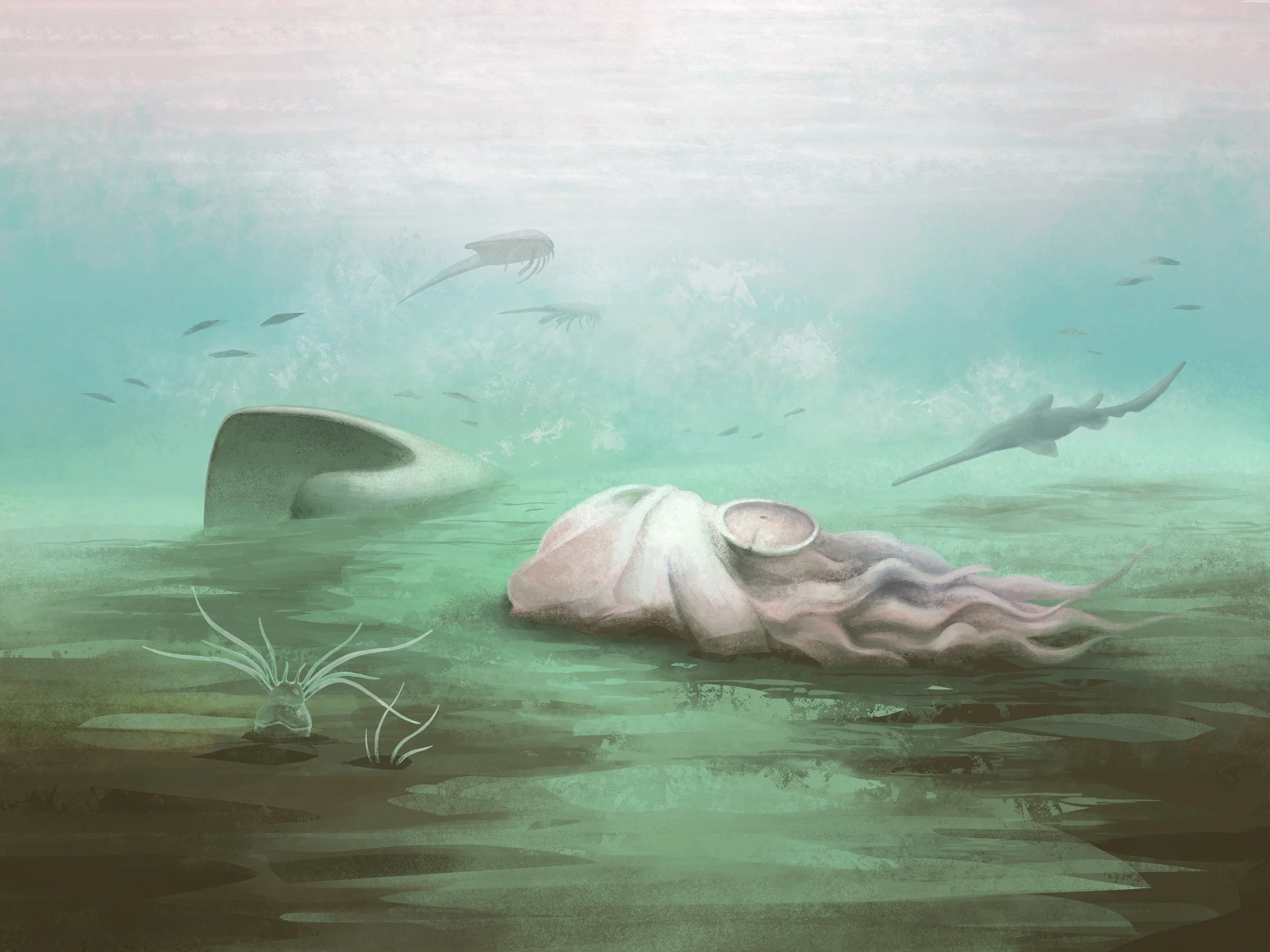
Paleocadmus decaying on the bottom of Mazon Creek. Credit: Franz Anthony
This post originally appeared in Riley’s newsletter The Boneyard. To support independent science writing and get stories like this direct to your inbox, subscribe on Buttondown.
I can only imagine the patience required of fossil octopus experts.
Octopus are squishy. Their principal hard parts are their beaks and, in some deep sea species, an internal shell that anchors swimming fins. But that’s just about all. At least with ancient sharks, the fish were constantly dropping teeth into the fossil record even when their cartilaginous skeletons were more likely to rot away. Ancient octopus had a limited number of hard parts per individual, held in mostly soft bodies that readily decayed away. They are not easy to find. Which is why Pohlsepia mazonensis was such a stunning discovery.
You’ve probably heard of the famous Mazon Creek fossil beds of 300 million years ago because of that lovely enigma, the Tully monster. But even those beautiful fossils undersell how spectacular the Mazon Creek layers are. Fresher and saltier bodies of water alternated back and forth during the Carboniferous, supporting different faunas including everything from sharks to spiders. Conditions were so right that even soft-bodied animals that normally rot to nothing were encapsulated in fine detail within rocky concretions. Pohlsepia was found in such a lump, as described in 2000, what seemed to be the world’s oldest octopus.
Up until Pohlsepia, the most ancient fossil octopus dated to the Jurassic. The Mazon Creek fossil pulled octopods back over 150 million years. Fantastic as it seemed, the sac-like head, eyespots, and arm crown all looked just like those of an octopus, and the animal seemed to lack any kind of elaborate shell that would identify it as a different form of cephalopod. But now paleontologist Thomas Clements and colleagues have offered a new interpretation of the animal’s anatomy. Pohlsepia is not an octopus, but a fossil of a rotting nautiloid.
Pohlsepia had been decaying when the fossil formed. No shell was preserved. Maybe the body slid out, or was pulled out, of the shell before being abandoned.
The rot had created a false signal, and yet still provides a first. The body looked like an octopus because the animal had been rotting on the bottom for days to weeks before mineral-laden sediment accumulated to make the fossil, the extra-glorpy nature of the cephalopod’s anatomy making it difficult to tell, for example, whether some features are “fins” or parts of internal nautilus anatomy that had been smushed out to the side.
Such finds are not uncommon among the Mazon Creek fossils. Different specimens of the same species are sometimes called taphomorphs of each other - the same species but in differing states of decay. There only seemed to be one Pohlsepia known, however, so there didn’t seem to be other comparable fossils. Only, there just might be now.
There are nautiloid radulae from Mazon Creek, Clements and colleagues point out, referred to Paleocadmus herdinae. The radula of “Pohlsepia” resembles these other fossils, and likely represents a second species - Paleocadmus mazonensis. But this shift underscores why the misinterpreted octopus is still important. Paleocadmus herdinae is only known from the hard mouth parts. P. mazonensis, while a blobby mess, nevertheless represents a glance of the animal’s soft tissues. We finally have some kind of soft tissues to go with the jaws.
The flip makes me think of all the times I’ve passed by a creek or lakeside, spotting a decaying fish or a half-eaten crayfish slowly being covered by sediment. If they become fossils, they won’t bring us a pristine look at the living animal. They could even be misinterpreted, a reminder that fossils tell us about an organism’s death and geologic transformation - but perhaps not as much about its life as we might think. But they carry so much more character with them, bearing the marks of their environment and the story of the fossilizatio0n process. Bodies can take a lot of punishment, fleeting as they may seem, and half-rotten carcasses can still make amazing fossils.