Taken By the Throat
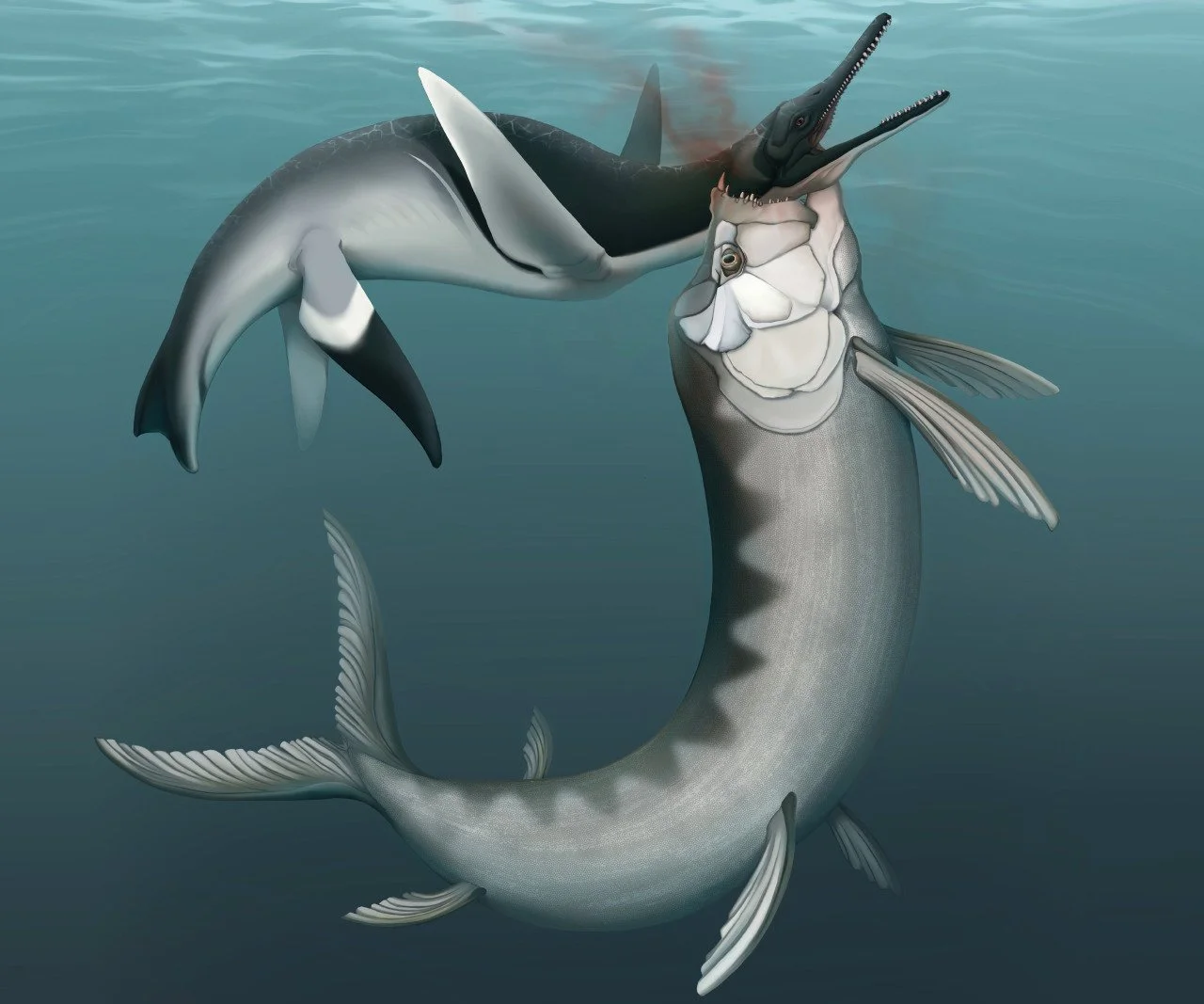
The attack probably occurred at the surface. Credit: Miles Mayhall
This post originally appeared in Riley’s newsletter The Boneyard. To support independent science writing and get stories like this direct to your inbox, subscribe on Buttondown.
Plesiosaurs breathed air. At intervals, among every body of water they inhabited, the marine reptiles rose to exhale mucus-flecked and oxygen-depleted air as they took another enriching breath. The need left them vulnerable. A tooth driven deep into a plesiosaur neck bone is the proof.
FMNH PR 187 is a stunning skeleton in its own right. The plesiosaur, collected 77 years ago near West Green, Alabama, was one of the gawky, long-snouted forms paleontologists know as Polycotylus latipinnis. After death, the marine reptile drifted down into oxygen-depleted bottom waters in the Late Cretaceous and was blanketed so thoroughly that experts have most of the skeleton and a suite of skull pieces to study. But it’s one particular bone, a neck vertebra from the middle of the series, that drew the attention of paleontologist Stephanie Drumheller and colleagues.
The fact that the hapless Polycotylus was bitten by something has been clear since the time of the plesiosaur’s discovery. But bites can happen for all sorts of reasons, at various times. A bite mark, or even embedded tooth, might represent scavenging rather than predation, or perhaps even a fight. The experts had to get a better look at the embedded portion of the tooth to start picking apart what must have happened. Thankfully, we live at a time when CT scanning fossils is relatively accessible and commonplace. Lo and behold, the essential details were held safe in the bone that was so viciously chomped.
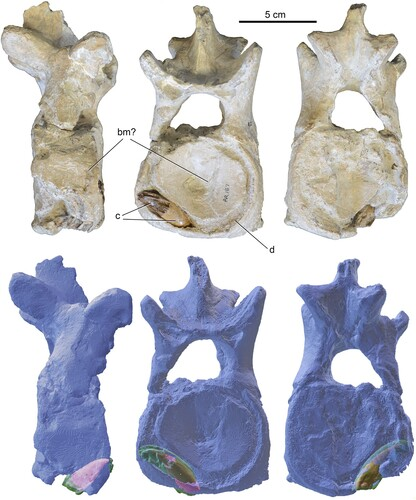
Three views of the Polycotylus vertebra bitten by a large fish. Credit: Drumheller et al. 2026
The tooth came from a massive fish. The details of the enamel, root, and other subtle features ruled out another marine reptile, like the sinuous mosasaurs that swam the same waters, and were wholly inconsistent with a shark. The best fit for the tooth’s owner is that most celebrated of hungry Cretaceous fish, Xiphactinus - the “bulldog tarpon.” Visit a museum and see a big “fish within a fish” fossil, and most likely you’re looking at Xiphactinus with its last meal.
Now, if we are good taphonomists, we can’t say exactly how the bite occurred. Perhaps the Polycotylus had died from some other cause and a scavenging Xiphactinus hit it hard. Then again, maybe the immense fish, just like great white sharks today, intentionally targeted its clueless prey as it took a breath at a surface. The plesiosaur’s skeleton is too complete to suggest a long window between death and burial, when varied marine scavengers would have likely taken out chunks for themselves, so the bite was almost certainly made sometime around the time of the reptile’s death. The Polycotylus - alive or dead - was likely at the surface, was bitten, and soon was opened up or degassed to the point that it sank to anoxic bottom sediments where it could literally rest in peace.
But it’s hard to look at the tooth and shake the impression that this was a quick, violent strike meant to incapacitate the reptile.
The location of the bite hints that the fish intentionally targeted the neck. “The positioning of this bite,” Drumheller and colleagues write, “would have almost certainly proven fatal to the Polycotylus due to disruption of the viscera of the neck and its contents, including the cartoid neurovascular bundle and the trachea.” Blood vessels, windpipe, sensitive tissues punctured or crushed. The meat-to-bone ratio in this area was not great, further suggesting that this was not scavenging but intentional hunting.
Imagine, exhaling to take a breath only to have your throat violently pinned shut by curved teeth.
We don’t often encounter such stories in popular visions of the past. Mesozoic reptiles are always meant to be the “dominant” forms of life wherever they occur, set apart from other creatures of their time. Plesiosaurs are supposed to eat fish. Fish are not supposed to eat plesiosaurs. And yet, there, impaled in the bone, we find the contradiction to our visions to the Age of Reptiles. Nature will always defy the roles and rules we impose upon it. Just ask Xiphactinus.