Get Over Here, There's a Giant Fossil Scorpion
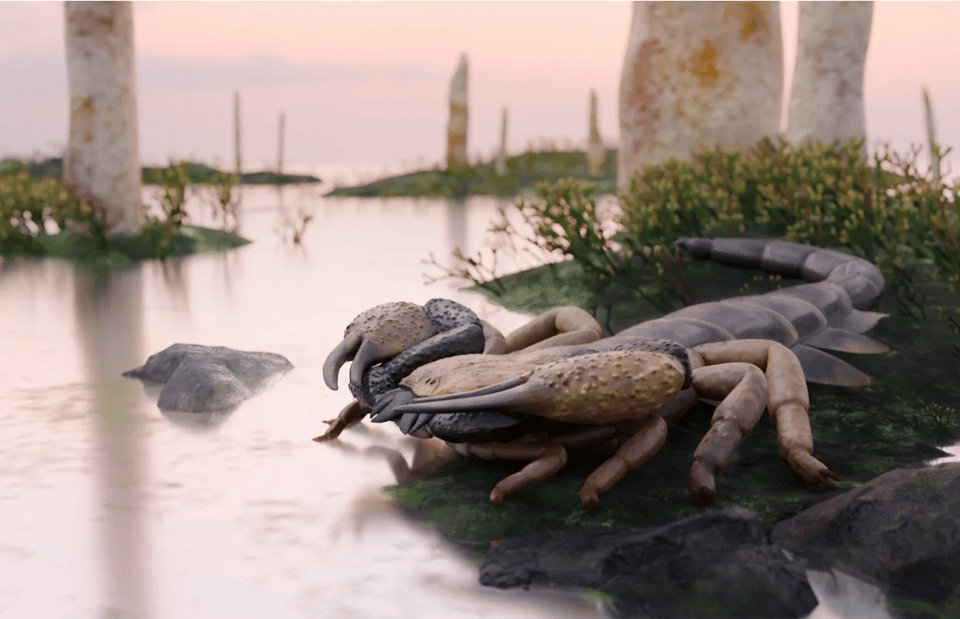
Praearcturus gigas is the largest scorpion yet known, from a time before our ancestors walked on land. Credit: Franz Anthony
This post originally appeared in Riley’s newsletter The Boneyard. To support independent science writing and get stories like this direct to your inbox, subscribe on Buttondown.
He thought it was an isopod.
The ancient fossil parts were big. There was no doubt about that. One pincer claw of the ancient invertebrate was larger than the vast majority of arthropods. The creature that owned the claw, paleontologist Henry Woodward told his colleagues in 1870, must have been giant. The closest match he could find was among gangly isopods like the much smaller Arcturus, a spiky cousin of the woodlice that so often amble across sunny paths. Prearcturus gigas seemed a fitting name for such a predecessor.
Woodward had no idea he had named the largest scorpion of all time.
Paleontologists had long supposed that Prearcturus was not the isopod Woodward thought it was. There was just something that seemed scorpion-like about it, though it was hard to be sure. Which led paleontologist Richard Howard and colleagues to go back to the classic fossils, as well as other ancient invertebrates, to resolve the puzzle. The scorpion suspicions were right. More than they knew.
The known fossils of Prearcturus gigas are from the early portion of the Devonian, about 415 million years ago. Plants were greening the land during this time, sticking close to the water but growing ever-higher. Invertebrates were beginning to spend more time out of the water, as well, literally chewing the scenery as they enjoyed food sources in a terrestrial realm largely free of predators. But not totally. As Howard and coauthors suggest, immense scorpions over three feet in length may have been the first truly large terrestrial predators on Earth.
While there were other large invertebrates in the world early in the Devonian, like the related sea scorpions more specifically known as eurypterids, several features pinpoint Prearcturus as a scorpion. The portion of the exoskeleton known as the sternum, for example, is very similar to an “unambiguous scorpion” called Eramoscorpius. The pedipalps in front of the mouth of Prearcturus, too, are large and have a fixed part and a moving part, almost like a lobster claw, and is a characteristic feature of scorpions. The assessments even allowed several other Devonian scorpion species to be folded into Prearcturus as they appear to belong to the same species - even though it is sad to lose the name “Brontoscorpio,” the “thunder scorpion.”
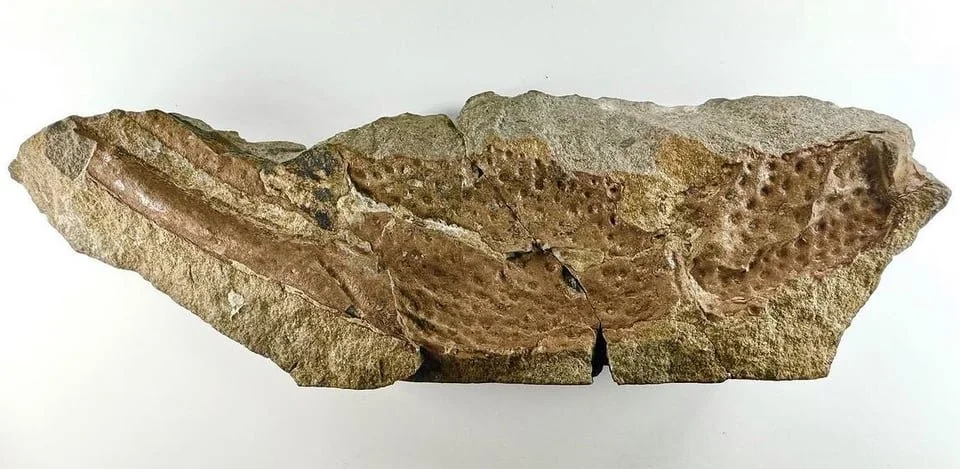
Watch your cheeks, it’s the pincer of Praeacrcturus gigas. Credit: NHM London
On land, no known arthropod of the time was as large as Prearcturus. And given how similar the fossil arachnid’s anatomy is to most scorpions, it was probably a pinchy predator that picked apart smaller prey. Timing might explain how it got so big.
So far as paleontologists have been able to tell, fishy amphibians and amphibious fish only started venturing further onto land during the middle part of the Devonian, about 15 million years after Prearcturus. The amphibious invertebrate must have enjoyed easy pickings on land during a time long before vertebrates were gobbling insects from the water’s edge and could eat so many juveniles of giant arthropods that the species could no longer hit their full size. Then again, the scorpions may have gone back to the water long before tetrapods started putting pressure on terrestrial arthropods. For now, it simply seems to be a matter of a scorpion lineage able to spend time on land enjoying the relative peace, and ample morsels, of the early forest.
Despite being the largest known terrestrial scorpion, Prearcturus was far from alone. The new paper has an entire section headed “Early scorpions were giant & numerous.” At least six giant Palaeozoic scorpions have been found so far. Devonian forms like Prearcturus were followed by Gigantoscorpio, Titanscorpio, and others in the Carboniferous, when thick, sweltering forests were filled with alligator-like amphibians in weedy ponds and lizard-like vertebrates scurried around tree trunks. The scorpions were taking the role of large terrestrial predator, and perhaps their amphibious capabilities had something to do with it.
Even though Prearcturus is restored in a terrestrial setting in the wonderful art by Franz Anthony, and the authors of the new paper consider the importance of the terrestrial realm to the invertebrate, the scorpion was probably still very aquatic. It may have been more like a horseshoe crab, most at home in the water but able to come out onto land for a while if its gills stayed wet. Rather than ballooning in size thanks to staying on land, the arachnids were fueling their growth with easy terrestrial prey while still growing to large sizes thanks to spending much of their time supported in the water.
The existence of giant-size arthropods on land long before the Carboniferous times of the immense millipede Arthropleura, giant dragonfly-like insects, and other huge species underscores how much we have to learn about how life settled in on land. Differences in ancient oxygen levels can’t explain what experts are finding. Arthropods of the Devonian and Carboniferous have to be understood as living at the intersection of land and water, not as inextricably moving from one to the other as narratives of evolution often simplify. Scorpions may have done well because they were able to wander places few other invertebrates could at a time when the first forests and land-dwelling faunas were just becoming established, plucking up other intrepid arthropods from among the liverworts and clubmosses. Scorpions sampled some of the earliest terrestrial ecosystems, tasting the change evolution can bring.