Some Fish Will Never Learn
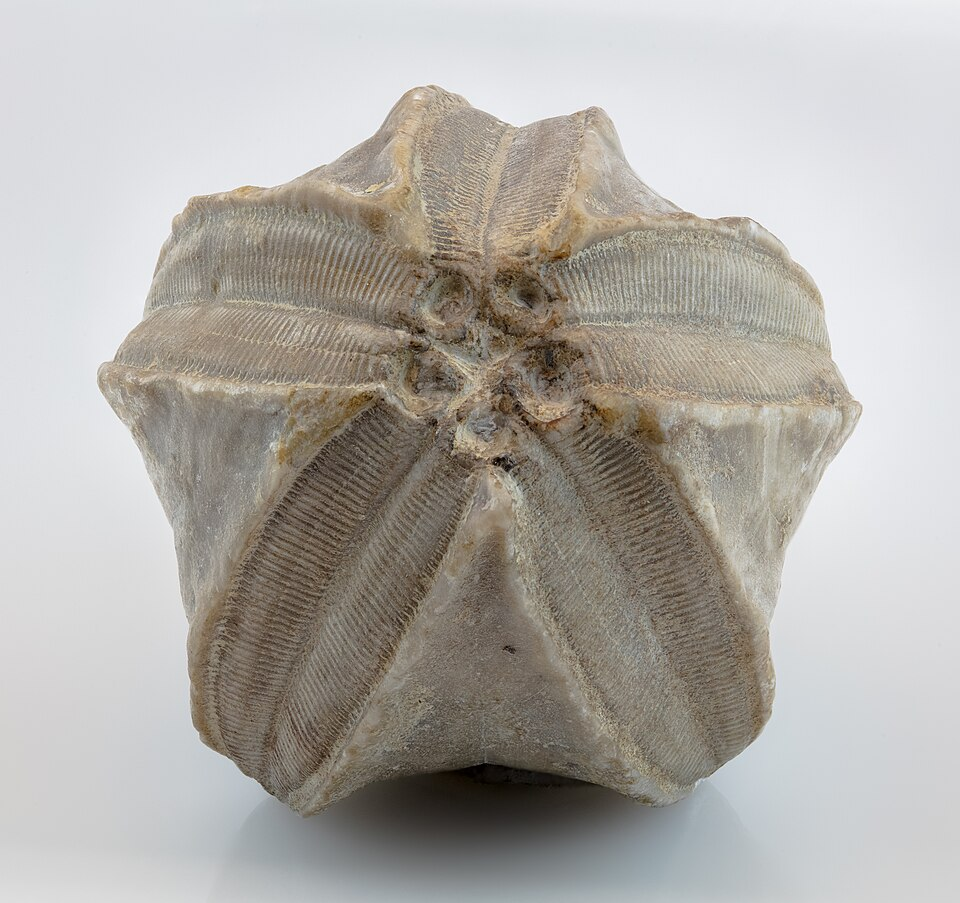
A stacked image of the blastoid Pentremites, an extinct relative of crinoids and starfish. Credit: Diego Delso CC BY-SA 4.0
This post originally appeared in Riley’s newsletter The Boneyard. To support independent science writing and get stories like this direct to your inbox, subscribe on Buttondown.
The fossil looks better suited to impact play than an ancient food source. Then again, to be entirely fair, the star-shaped buttons only represent part of the living animal that was anchored to the sea floor roundabout 325 million years ago. Back then, the creature would have looked a little closer to Jean Jacket, stubby cords ending in rounded buttons covered in dozens upon dozens of thread-like wisps that could be folded in or spread to the sea.
There wasn’t much on such blastoids to sink one’s teeth into. The hard external shell was made of interlocking thecae, vaguely similar to the hard parts of sand dollars and sea urchins today. The waving expanses of the breathing and food-catching apparatus, the brachioles, didn’t offer much, either. The biological threads were almost hairlike, they were so thin, lacking any kind of internal fluid systems or nutritious tissues that would be worth a passing fish’s while.
And yet fish bit these animals, repeatedly, gouging their parallel teeth into the armor only to learn that blastoids aren’t bothering with.
I first heard of these fossils thanks to paleontologist Stephanie Drumheller, a renowned expert on ancient bite marks and how fossils become fossils. You can have a look for yourself in the journal Lethaia, where Drumheller has documented the Carboniferous damage with colleagues Colin Sumrall and J. Richard Kyle. The scratched-up blastoids are proof that the past very was much like the present when it came to feeding - sometimes predators picked the wrong prey.
Kyle had gathered the damaged blastoids in a collection held at Tennessee Tech, the scratched echinoderms later catching the eye of Sumrall. The scrapes looked like bites. “He quite literally walking into my office with a handful of blastoids, dropped them in my hands, and asked me ‘Are these what I think they are?’”
And they were. No one can be sure the precise species of fish that tried to crunch into the blastoids. This is common in ichnology - being able to tie a trace to a specific tracemaker is a very fraught task if it’s being done with adequate care. (The fossil record is incomplete, perhaps the body fossil corresponding to the trace has not been found yet, a single animal can make many different kinds of traces depending on all the variations of how it moves and what it’s interacting with.) The case is even further complicated by the resilience of the blastoids. The animals had not been crunched apart by the ancient fish. They’d merely been injured, signs of healing both indicating that the blastoids survived these assaults and obscuring some of the toothy details the fish left behind.
“At the end of the day, the only things we could think of that might produce neatly-aligned rows of similarly-sized, American football-shaped punctures were teeth,” Drumheller says, and plenty of Carboniferous fish had such choppers.
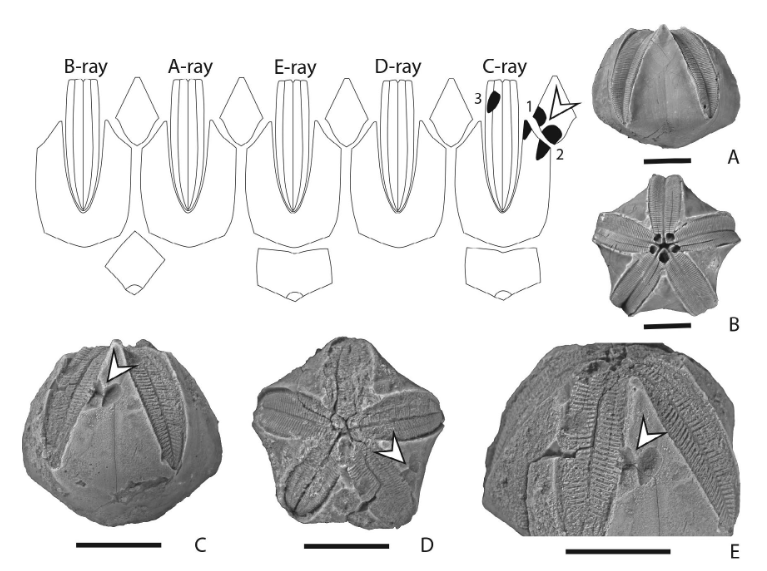
Diagram of Pentremites spicatus showing several elongated bite marks on the outside. Credit: Drumheller et al. 2026.
Bite marks and signs of feeding fish aren’t all that uncommon on fossil echinoderms. Our distant deuterostome relatives have long possessed incredible regenerative abilities, producing lost appendages and sometimes entire bodies, and have such low metabolic needs that losing a body part, like a clump of brachioles, wouldn’t be a big deal. But the bites on the blastoids were unusual for how repeatedly unsuccessful fish seemed to be at eating them.
Back in the Carboniferous seas, a fish going in for a nibble on a blastoid would have had to bite through or otherwise contend with masses of brachioles folded up over the body of the blastoid. It doesn’t seem like the fish were after the wisps. They were trying to get into the blastoid’s body. “Pentremites thecae are particularly thick-walled,” Drumheller says of the genus of the center of the new study, “which would have made breaking them open even harder.” Perhaps some fish did, but blastoids were not exactly lush with interior soft tissues, either.
Nature does not unfold by the rules of facts on file cards or technical reports of gut contents. Animals will try new foods for novelty, because there is nothing else, or perhaps because something else tasty is living on another creature. Ancient fish ate other, fleshier echinoderms. Why wouldn’t they try a blastoid? Trying to piece together the logic of Carboniferous fish is a task fraught by cognitive, temporal, and oceanic gulfs. What we know is that fish kept doing it, just the way sharks famously ingest things we don’t expect - whether out of curiosity or some other reason. It’s a reminder that there is no strict balance between specific predator and prey, dedicated evolutionary arms races arranged in inviolate food webs. Animals do weird things sometimes. I think Drumheller’s explanation is as good as any.
“I’ve been joking that these fish were just out there making poor life choices.”