Guess What? Protomammal Butt
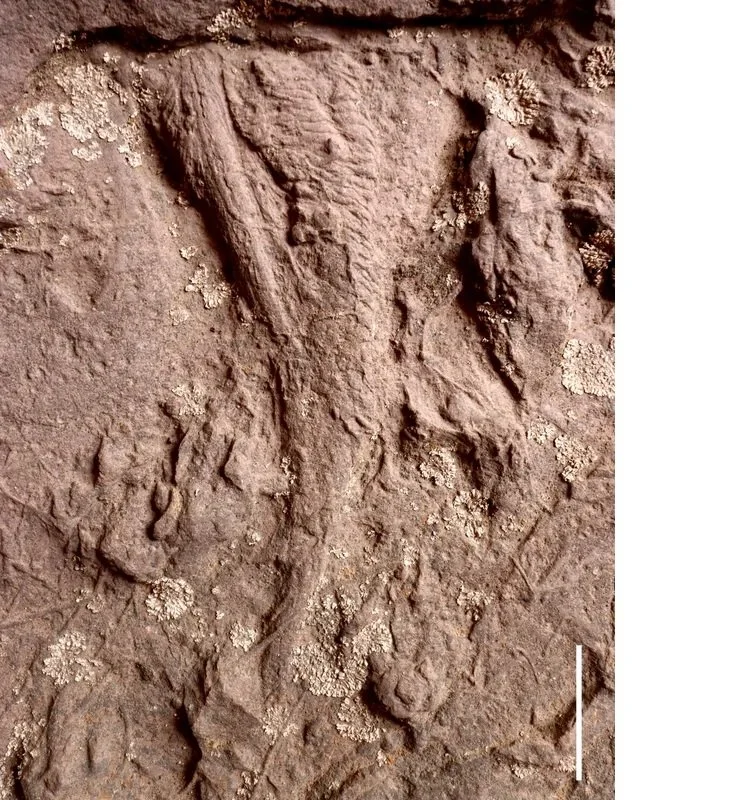
A tail impression most likely made by a type of protomammal called a caseid. Near the top right, a V-shaped notch indicates the animal’s cloaca. Credit: Museum für Naturkunde Berlin
This article originally appeared in Riley’s newsletter The Boneyard. To support independent science writing and get stories like this direct to your inbox, subscribe on Buttondown.
Eons ago, our ancestors had very different butts.
Not that I can really call a cloaca a “butt.” It’s more of an orifice, an exterior slit behind which sits a pocket where an animal’s urinary, excretory, and reproductive ductwork all let out. The sort of thing we find in modern day crocodiles, songbirds, and a handful of mammals that carry more ancient traits than we do. (You can even read up on the cloacal microbiome of the platypus.) But I invoke the term “butt” because it at least settles our considerations on the proper area of the body, the undercarriage, to properly appreciate what otherwise might look like just another reptilian smush in the ancient muck.
The fossil represents a brief moment in the swampy days of 294 million years ago. Our ancestors looked more reptilian back then. Still relatively new creatures on our planet, synapsids superficially looked like the forerunners of lizards and dinosaurs, yet were distinguished by a single opening at the back of the skull instead of the reptilian condition of two. And so when paleontologists realized that a tail-impression on a fossil slab from Germany’s Bromacker Quarry with a cloaca visible on it, there was a good chance it was made not by a reptile but a protomammal.
In fact, the most likely tracemaker for the various steps and scrapes around the tail impression is an synapsid found in the very same quarry called Martensius. Despite the creature’s monitor lizard-like body and comically-small head, Martensius is a synapsid - not a direct ancestor but a close cousin, nearer to our ancestors of that time than any reptile. When a Martensius took a moment to lay its body in the mud in ancient Germany, it left a pretty detailed impression of its underside anatomy. The sediment gradually hardened enough to hold the shape as new sediment washed over the trace, which allowed paleontologists to uncover and identify the fossil as the oldest representation of a protomammal cloaca.
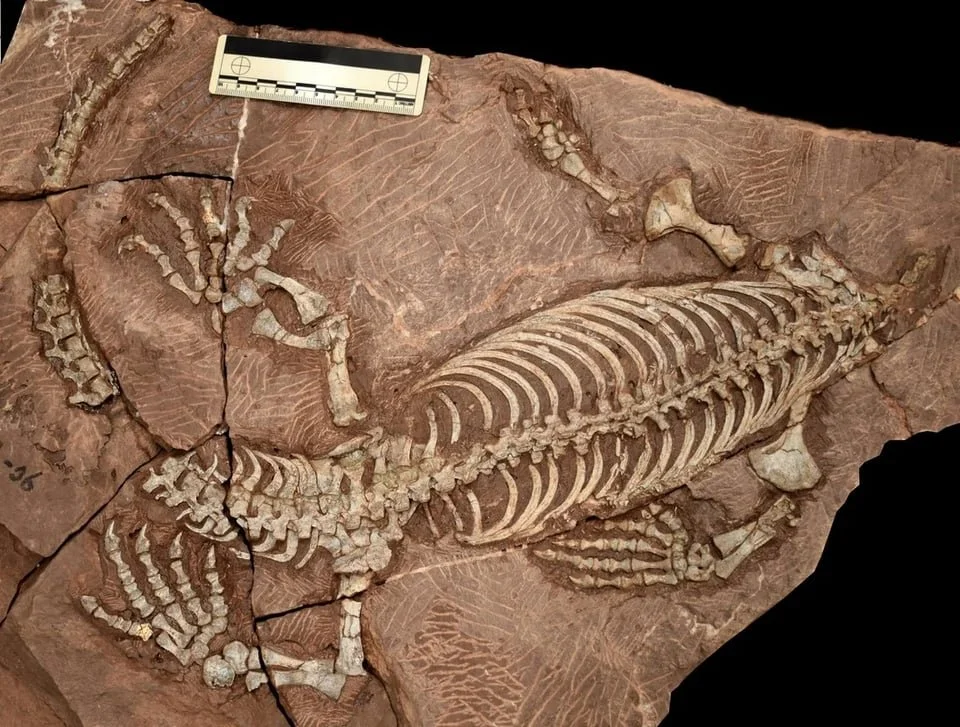
A skeleton of Martensius, lacking the skull. Despite the animal’s lizard-like appearance, Martensius was more closely related to us. Credit: Museum für Naturkunde Berlin
Lorenzo Marchetti and colleagues have the details in iScience. There are some caveats to keep in mind with the fossil’s interpretation. It’s an incomplete impression and only gives us a good view of the cloaca from one side. We cannot be certain that Martensius was the tracemaker, either. The tail is assumed to belong to the synapsids that left footprints around it, but, though a small possibility, another animal could have left the trace. The tiny-headed Martensius is found in the same quarry, is the right size, and is the best match for both the footprints and cloaca impression, but the only way to be one hundred percent sure would be if a Martensius had somehow perished and buried right in a trackway containing the cloaca trace. The authors make a solid case that the cloaca impression was made by a synapsid, though, and that’s the critical part.
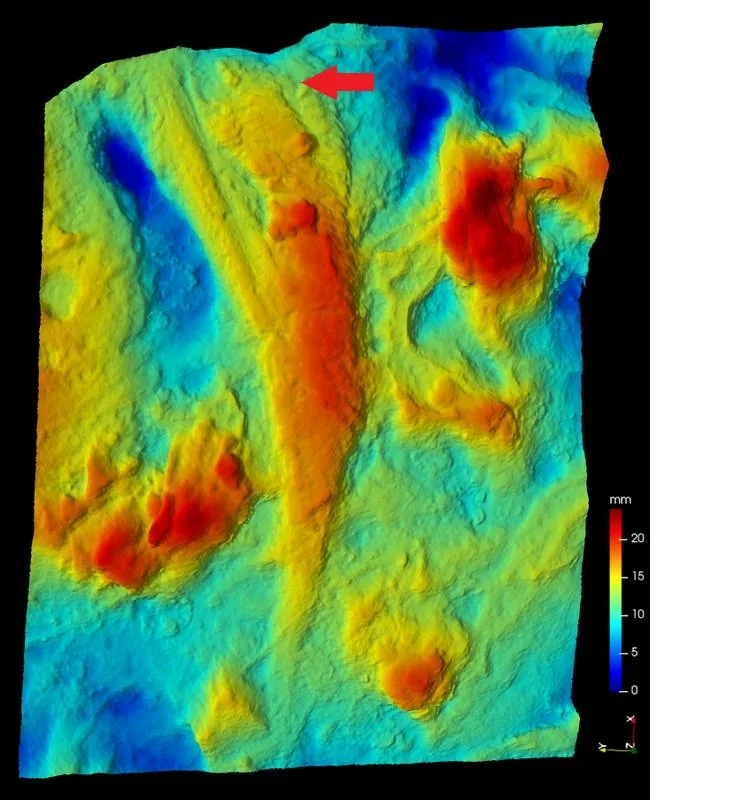
Heat map of the tail fossil showing the cloaca, emphasized with an arrow added by RB. Credit: Museum für Naturkunde Berlin
The cloacal opening itself is nothing more than a wobbly vertical slit near the top of the impression, where the tail thickens and met the living animal’s hips. The vent appears wrinkled, with lips to either side, not unlike the setup in living crocodiles.
The vent’s vertical orientation could be an indication that the last common ancestor of all living tetrapods had a vertical vent, too, the Bromacker synapsid carrying on this ancient orientation. The paper’s “Table S1. Database of cloacae external morphology” lists some fossil occurrences with observations of modern animal cloacae, and the authors note that modern amphibians considered to be more archaic have vertical vents. Horizontal vents seem to be modifications, perhaps related to new functions such as keeping more water inside the body, display, defense, and more. But we also don’t have enough fossil butt impressions to tell exactly when or even why external cloaca vents changed between portrait and landscape.
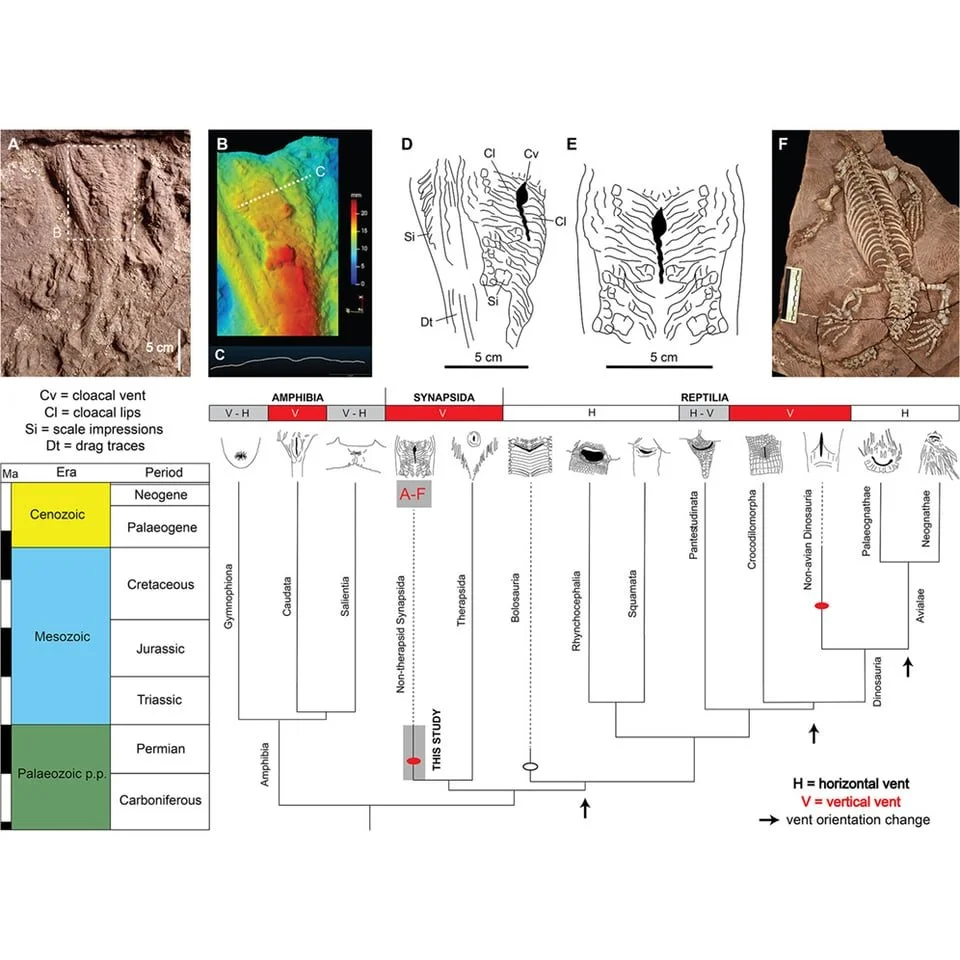
Vertical vents may be the ancestral condition, various animal lineages shifting to horizontal over time. The reasons why are unknown. Credit: Marchetti et al. 2026.
I don’t need the answer right now. Because I’m a little beside myself that I never stopped to consider what kind of genital setup our protomammal ancestors had and when that changed into the more anatomically discrete setup we know so well. I’ve enthused about dinosaur cloacae, because it seemed pretty obvious that the reptiles would have such orifices and it felt like a vindication to see one found. I just didn’t think about synapsids. When did all those soft tissue pathways change from being held behind an external slit to what we so intimately know in ourselves? My ancestors and yours used to have cloacae. When did that change?
I have to admit that we may never known. Whether through trace fossils or rare soft tissue fossils, the cloaca is hard to find. Then again, perhaps the recent discoveries of the orifice in a dinosaur and now a synapsid will send paleontologists back to their collections and half-remembered, exceptional fossils, finding what was always there but overlooked. Perhaps both can be true. And new finds are being made all the time in the field. I’d just like to know. Anatomy both opens the possibility of new behaviors and constrains them. Apparently losing a cloaca and shifting all the plumbing around worked for our ancestors and relatives, perhaps related to the demands of life on land, but did it have to be so? Could it have been an evolutionary accident, a developmental shift nudged by another change that locked in a different anatomical setup that our ancestors have carried along since the Cretaceous? Monotremes and some marsupials have a cloaca or the remnants of one, suggesting that the shift happened among the ancestors of us placental mammals. Evolution is also capable of reversals and unexpected resurgences, working back around to “lost” traits, which requires a check against our imperfect fossil record. For the moment, the answer is being held tight.
But I can’t nitpick the fossil record today. I can’t be mad at the interaction of the geological and biological that safeguarded a fleeting moment that’s changed the way I look at my own history.
Sometimes paleontology is a real kick in the ass.