Underwater, Seals Can Hear You Bark
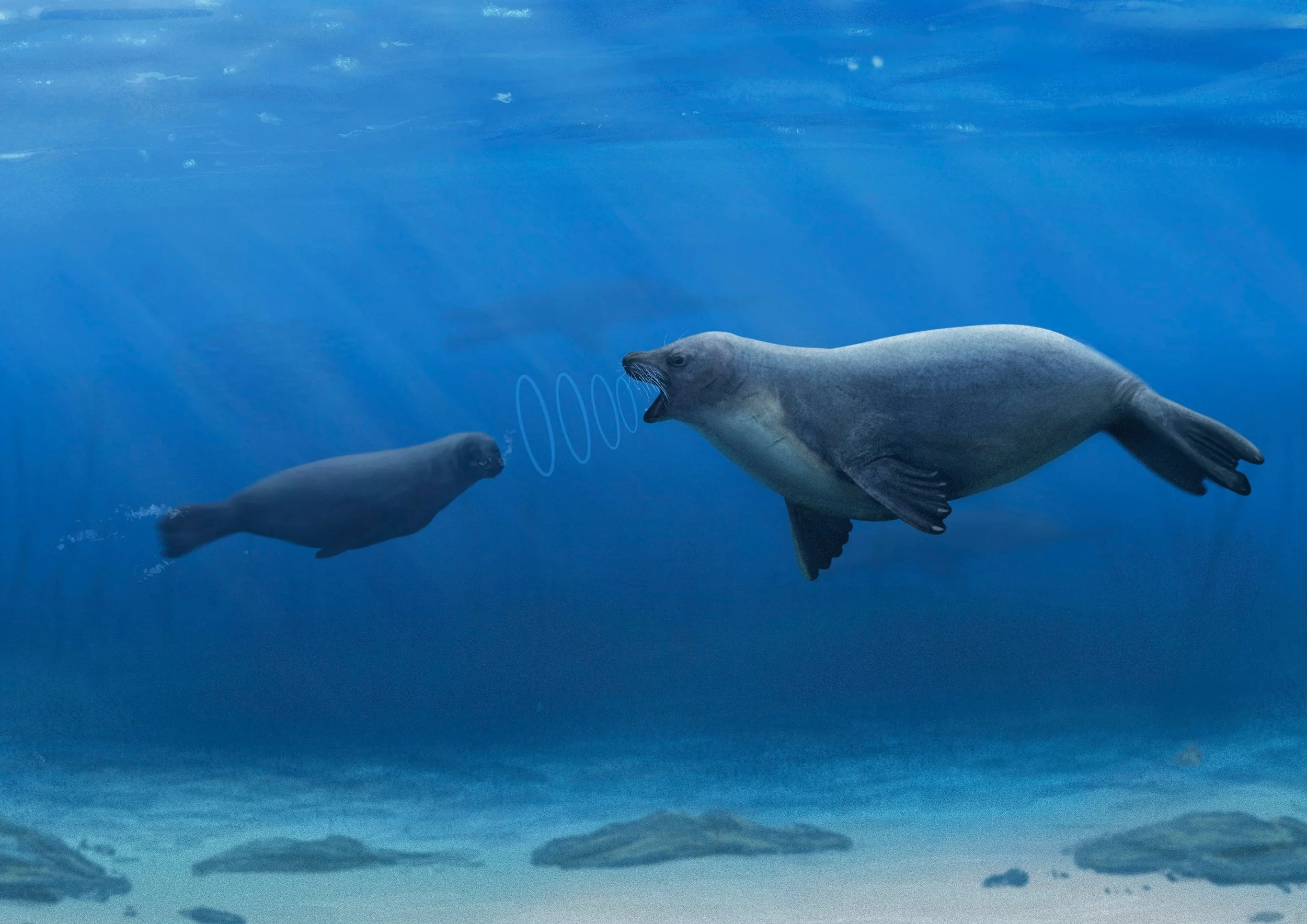
Pick up, it’s Devinophoca calling. Credit: Jaime Bran
This article originally appeared in Riley’s newsletter The Boneyard. To support independent science writing and get stories like this direct to your inbox, subscribe on Buttondown.
The roll is muffled, but it’s still there. An unfurling
clonkclonkclonkclonkclonk
much louder now above the shove of the waves.
They’ve got a good voice. Acrophoca dips back down, suddenly folding her body in a chubby upside-down U, pushing with the broad webs of her feet to slide back down towards the bottom. She’s intrigued, but no summer sausage of a mate would be worth it if her distraction got her nabbed by heart-shaped teeth. She glides along, belly almost to the shells and tufts of sea greens just off the beach.
She trills, not that her counterpart can hear her up there. The clonks travel far because they’re deep, low-frequency calls. They can tease in the water. Her trills are more excited, involuntarily as Acrophoca considers her path up onto the beach - a favorite little draw among large boulders, just to the side of where her paramour grunts. She can hear them, though, a fact that makes her more special than she can understand.
Her distant, otter-like ancestors were only adept at hearing sounds traveling through the air. When the earliest amphibious pinnipeds began dabbling in the water, being submerged was to be in a muffled world where sight and touch were more important senses. Their ears were little different from those of their dog-like predecessors. But as early seals and sea lions made themselves at home in the water, something shifted.
Acrophoca can listen to sounds traveling through the air just fine. But when she submerges, cavernous tissue surrounding her internal ear tissues inflates to help equalize the pressure. The swelling helps connect the ear canal to the middle ear, meaning that sounds can also travel along the soft tissue pipeline to where they can actually be heard. As seal ears adjusted to cope with the literal pressure of swimming and foraging underwater, an accidental connection allowed the mammals to sense aquatic life in a way their ancestors could not.
Almost there now, and not even the shadow of a shark to impede her exit from the pool. She trills once more, snaking her head above the water as she rides a wash in on the sand. They’re gronking and clonking again, and maybe this time they’ll hear her answer.
How do seals and sea lions hear in the water and out of it? It’s been a challenging puzzle for anatomists. Land-dwelling carnivores similar to the animals seals evolved from can hear well through the air but can’t hear much at all underwater. Whales, on the other hand, committed so fully to life in the water that hearing through the air is practically irrelevant to them. And yet pinnipeds manage both, barking and trilling and hissing and clunking above the water and below.
A new study from biologist James Rule and colleagues has revealed how seals and sea-lions do it. The essential part is a specific lining of the internal ear called the cavernous tissue.
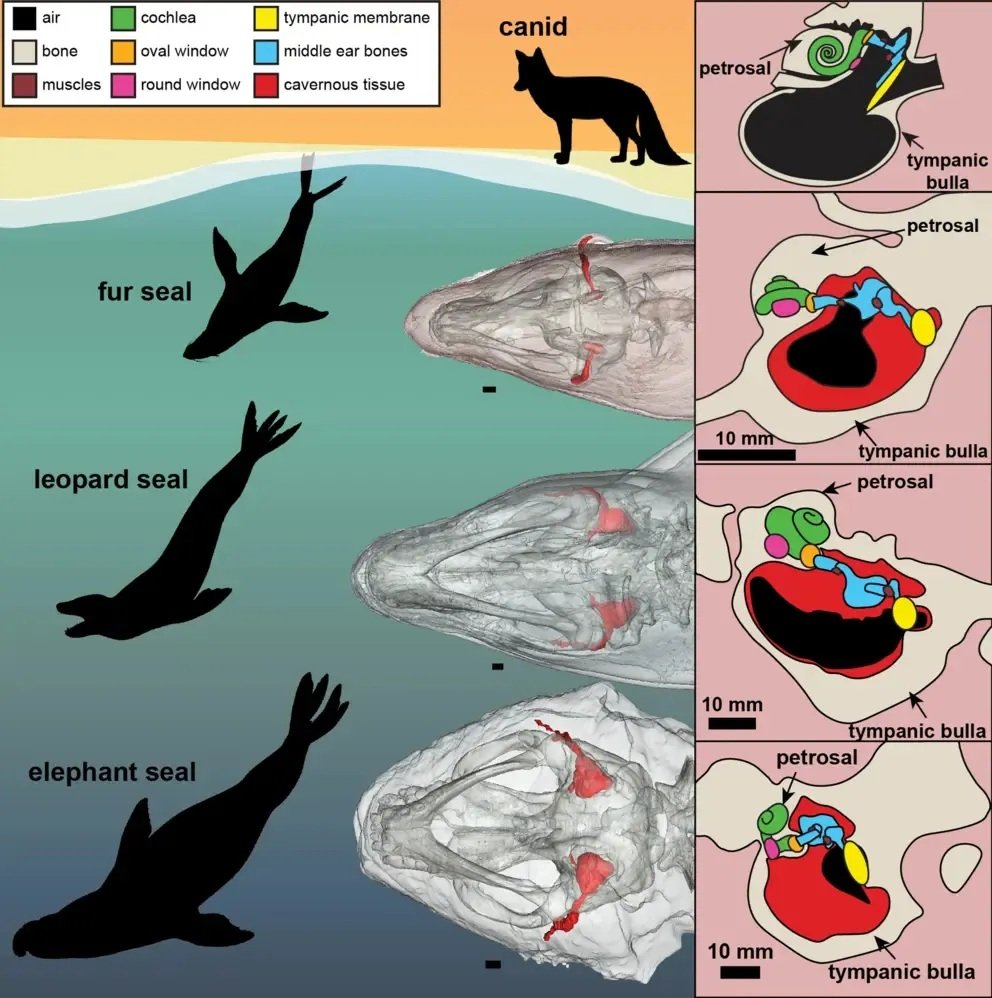
Land-dwelling canids don’t have the specializations that pinnipeds do for hearing underwater as well as through the air. From Rule et al. 2026.
On land, the cavernous tissue is relaxed. Pinnipeds hear through the air in a similar way to other carnivorans like wolves and bears, albeit without the large, dish-like ears to better tune-in to sounds. When pinnipeds dive, though, the cavernous tissue inflates. It likely evolved as a way to help equalize pressure as pinnipeds began to dive deeper and deeper after squid, fish, and other morsels, but it had an unexpected benefit. The cavernous tissue bridged the ear canal and middle ear, allowing underwater sounds to be transmitted and actually heard by the mammals. Rule and colleagues estimate that this occurred about 27 million years ago, just prior to when the seal and sea-lion lineages split from each other. Both groups inherited the basic ability to hear underwater, further refined independently in both groups.
The tale up top is inspired both by the ancient seal Acrophoca and leopard seals, considered a rough modern analog for the Miocene pinniped. We have no idea what sounds Acrophoca made, or if sound was critical to its courtship. The bones don’t say. But the seal’s skeleton and evolutionary history do tell us that sound was important to the beast, a mammal that carried along some of the snorting and barking of its terrestrial ancestors and could hear the sounds of its fishy prey. When we hear barking sea lions on a pier or the vocal thumps of a leopard seal, we’re hearing the latest sonic styles of mammals that have been making noise for five times longer than humans have existed on the planet.