Got You, Snaggletooth
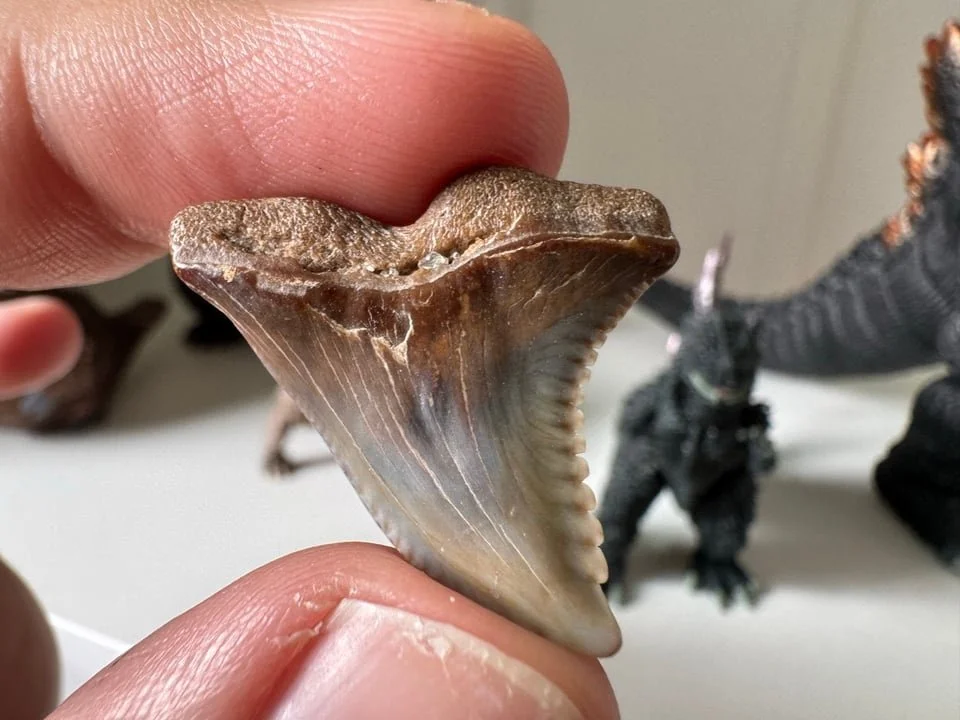
The snaggletooth shark that dropped this tooth more than 10 million years ago.
This post originally appeared in Riley’s newsletter The Boneyard. To support independent science writing and get stories like this direct to your inbox, subscribe on Buttondown.
“Oh my god. Oh my god.”
Splash immediately turned their head, eyes wide, from the sand. “What is it?” I was already laughing by the time the question left their lips. A snaggletooth. Hemipristis serra. The very shark I’d set out to find.
I already had a pretty good collection of teeth. The lower teeth of little requiem sharks, the crown of a small sand tiger, a false tiger, and some ray tooth plates, all gleaming dark against the lighter sand and shells in my strainers. I knew larger teeth were unlikely. I knew I was after a rarer species. But after Splash got a smooth-edged Carcharodon hastalis - a predecessor of today’s great white that preferred fish to marine mammals - I hoped that I’d get a lucky break, too. An hour or so later, the shallows were generous and my grin split ear to ear as I recognized the unmistakable serrations of the snaggletooth shark.
There’s one snaggletooth species still alive today. Hemipristis elongata - also commonly called the snaggletooth shark - is a roughly person-sized species that swims the coasts where the Indian and Pacific Oceans touch South Africa, Australia, China, and locales in-between. Their rough-looking teeth really do seem to stick out a little bit, giving them an edgier look than the smaller weasel sharks its related to.
We might be losing the modern snaggletooth. The shark is reportedly rarely seen, made vulnerable to extinction due to bycatch and the shark fin trade. It’s a shame for a genus that’s been around since the Eocene, once widespread through the world’s oceans but now primarily found along the continental shelves of the Eastern Hemisphere.
Hemipristis curvatus was among the earliest of its lineage, an Eocene species whose teeth are common collectables found in Morocco. H. tanakai, from the Oligocene of Japan, followed, but it’s H. serra that was really living large during the Miocene. The sharks were much bulkier than their modern counterparts - estimated to be 20 feet long or so, comparable to a very large tiger shark - and found broadly in fossil sites between 20 and 10 million years old.
Despite its prized status among collectors, though, very little is known about the paleobiology of H. serra. One of the few recent studies concerning the shark, by paleontologist Patrick Jambura and colleagues, focused on the inner structure of those slicing teeth.
Not all shark teeth are constructed the same way. Different lineages show variations in tooth development and even the organic materials the teeth are made of. Many sharks, including the broader relatives of snaggletooth sharks, have a pulpy cavity in their teeth surrounded by harder material under the enamel called orthodentine. Lamniform sharks like great whites, threshers, and sand tigers, however, don’t have the pulp cavity and instead have a center made of a spongier, almost bone-like material called osteodentine.
The difference reflects a big change in what sorts of sharks fill the seas. During the Mesozoic, when marine reptiles in every shape and size flourished in Earth’s seas, lamniform sharks were more diverse and common. They were the sharks. In the Cenozoic, however, lamniforms became more specialized as requiem sharks took over the more generalized shark role - hence why osteodentine in sharks like the great white seems unusual compared to the orthodentine found in other sharks. And yet, despite its family relationships, snaggletooth sharks evolved their own version of osteodentine to mix with the orthodentine gifted them by their ancestors.
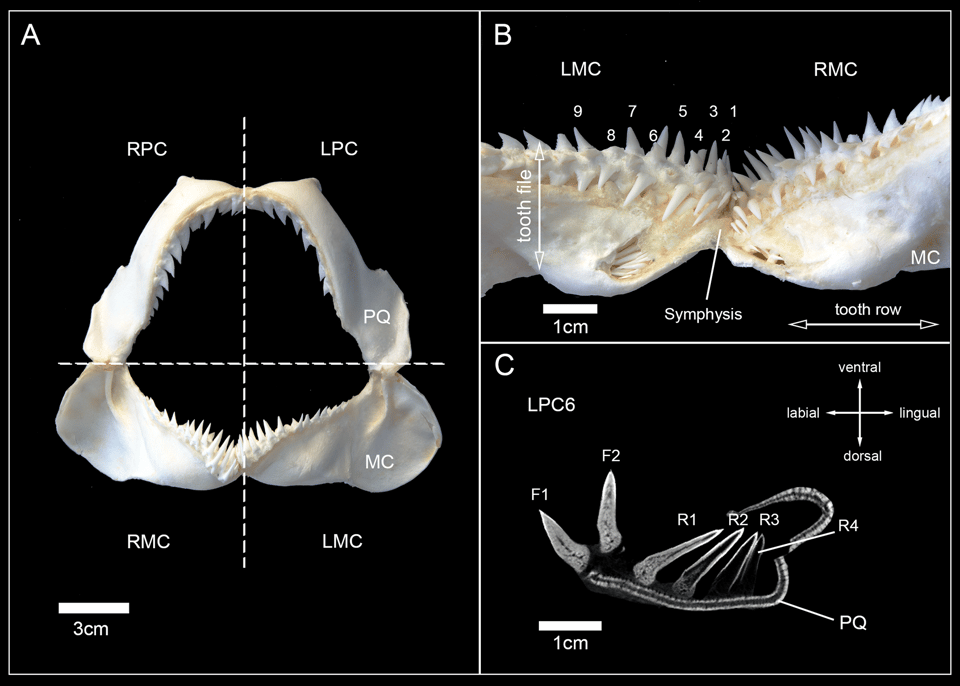
The jaws of the modern H. elongata, from the front, detail of the back inside, and side view of teeth forming in the jaw. From Jambura et al. 2021.
Jambura and colleagues call the condition in snaggletooth sharks “pseudoosteodont,” which is a bit of a mouthful. It matters taxonomically-speaking because the vast majority of what we know about sharks of the past comes from teeth. Being able to recognize how a tooth’s interior relates to what sort of shark it was can help sort families and track evolutionary lineages, especially if some shark species evolved to combine different tooth structure strategies.
The question is why snaggletooth sharks evolved teeth like those of makos and porbeagles. It would seem that combining the different interior tooth tissues would make each individual tooth stronger while keeping them elastic enough to resist breaking easy, perhaps while feeding on other sharks. Then again, Jambura and coauthors write, the overlying enameloid layer had more direct contact with prey and the interaction between the tooth layers during a bite is still poorly understood. The tooth changes almost certainly have something to do with feeding, and the role H. serra played in ancient seas, but that’s a bigger question than can be ascertained from some isolated teeth alone.
I wonder how this particular tooth found its way to the bottom. It looks like a shed, a tooth that did its service and tumbled out of the shark’s mouth in a completely regular, everyday moment, lilting to the bottom and finding its home in the sand, that became rock, that became sand, to be waiting for me one sunny Cenozoic Sunday.