Diplodocus Strolled Jurassic Spain
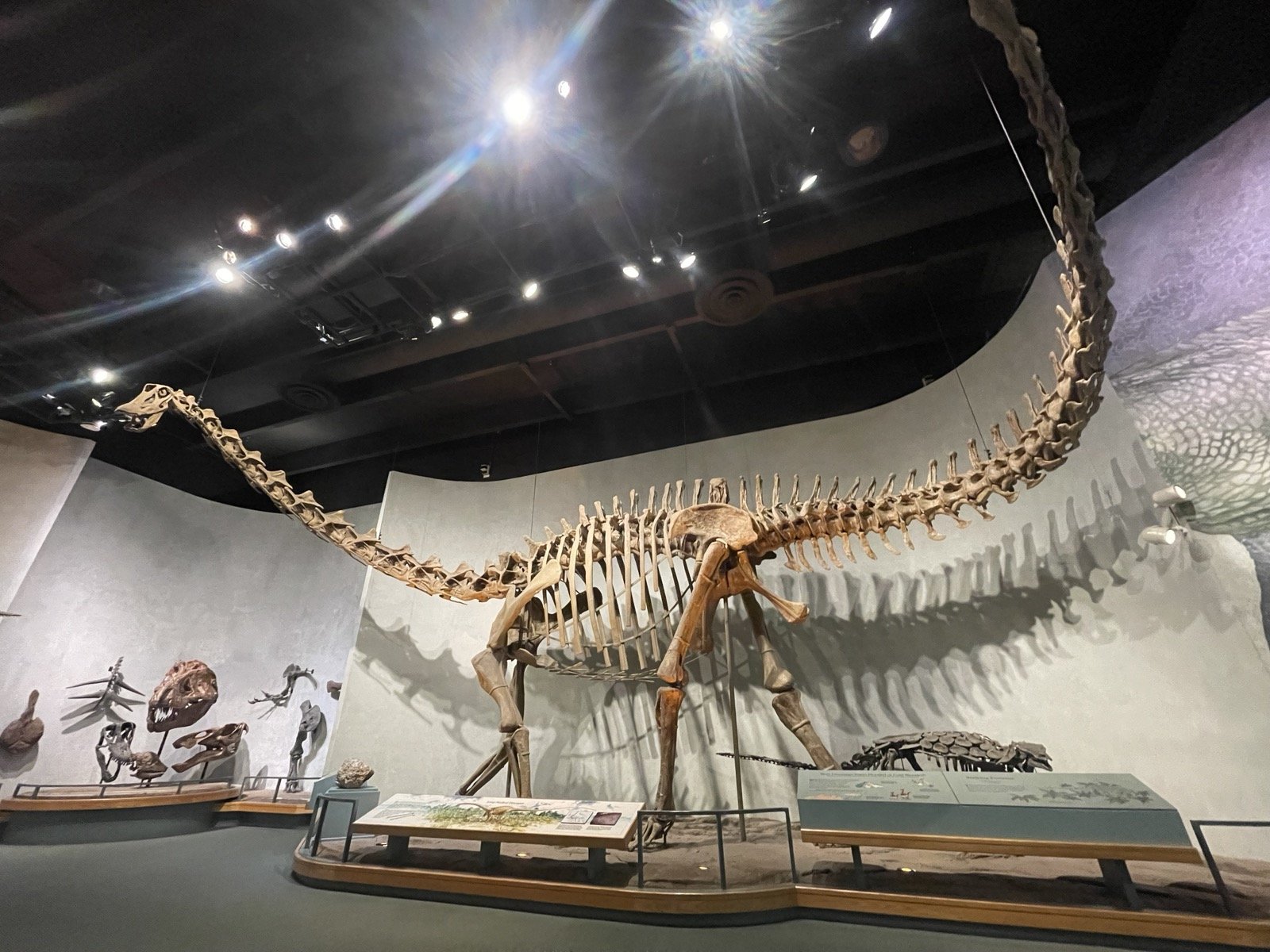
Diplodocus is an iconic North American dinosaur, now found in Spain, too. Credit: Riley Black
This article originally appeared in Riley’s newsletter The Boneyard. To support independent science writing and get stories like this direct to your inbox, subscribe on Buttondown.
Morrison Formation dinosaurs are icons. Allosaurus, Stegosaurus, Brachiosaurus, Ceratosaurus, Camptosaurus, and more, they’re reptiles exhumed in bone rushes and the creatures that formed our image of dinosaurs as large and strange. They’re so celebrated, in fact, that it’s easy to forget that some of these American creatures are found elsewhere in the world. The carnivorous Allosaurus and Torvosaurus, for example, are found in Portugal as well as places like Colorado. And now Diplodocus has been uncovered in Spain.
Around 150 million years ago, that favorite clean date for “Morrison Formation time,” ancient North America and Europe were still close together. Tectonic forces were pulling the landmasses apart from each other as what was once Pangaea gave way to a different arrangement of continents, but the Northern Hemisphere’s tracts were still chained to each other by continental shelves and archipelagoes. There must have been times when dinosaurs could pass between these slowly-drifting islands, because apparently they did.
Paleontologist Sergio Sánchez-Fenollosa and colleagues broke the news earlier this week. Within Teruel, Spain’s Arzobispo Formation, roughly equivalent to the Morrison Formation in the US, the researchers found a set of 14 tail vertebrae and a few associated bones. The vertebrae are distinctive enough to identify them as Diplodocus.
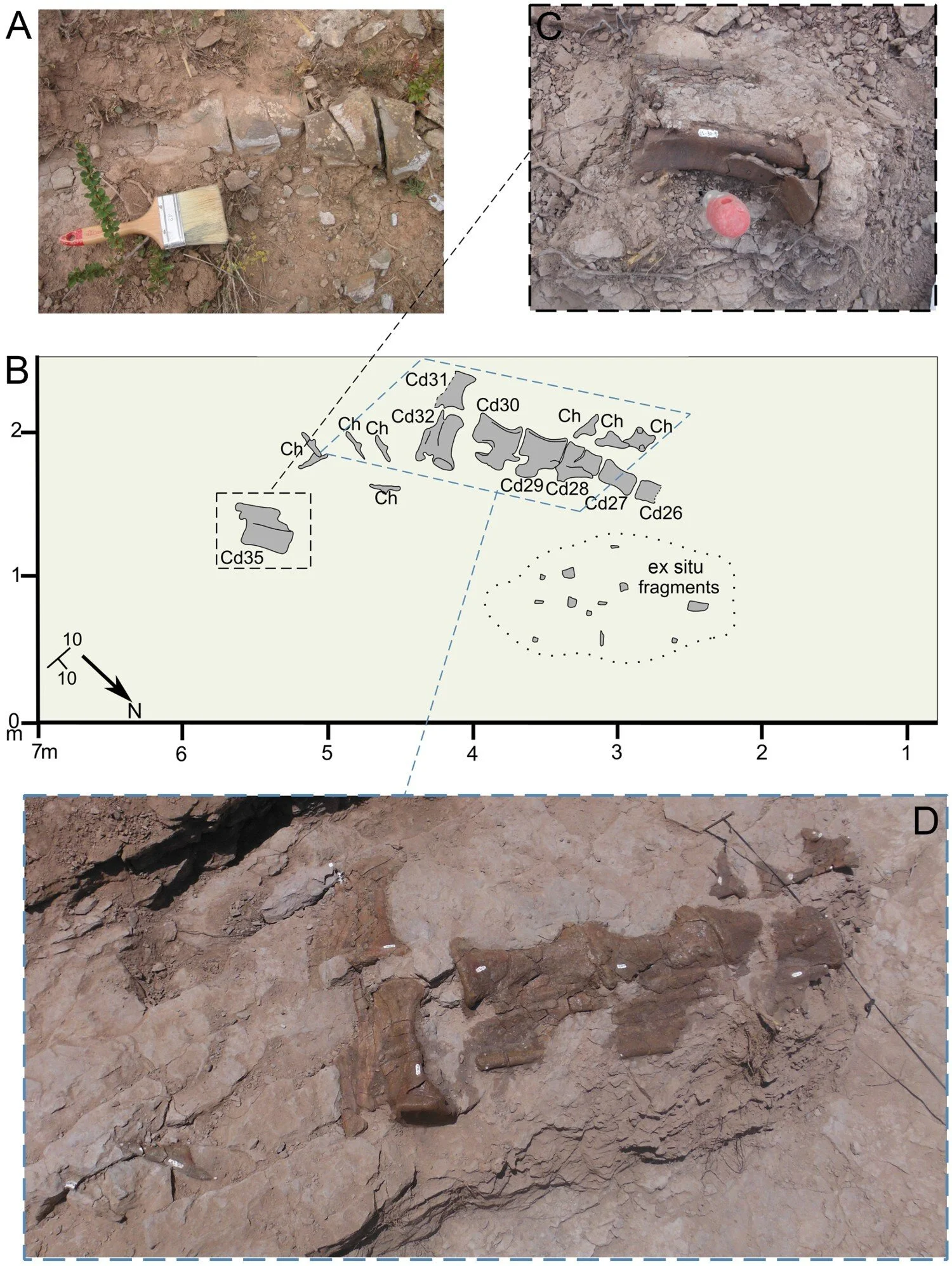
The Diplodocus from Teruel. Credit: Sánchez-Fenollosa et al. 2026.
Most dinosaur specimens are frustratingly scrappy. Sauropod dinosaurs, especially, were often so big that we just get body parts rather than anything even approaching complete skeletons. But the vertebrae of sauropod dinosaurs are so threaded with air sacs that these bones are among the most complex, distinctive, and informative in their entire skeleton. It’s often easier to distinguish sauropods on the basis of their vertebrae than their skulls (hence why the head of Apatosaurus was mislabeled as Diplodocus for more than half a century). More bones would have been better, but fourteen tail vertebrae offered Sánchez-Fenollosa and coauthors a decent sample for sauropod comparisons.
Anatomically, the tail bones most resemble those of other Diplodocus. The articular surfaces are like those of other Diplodocus and distinct from contemporary dinosaurs like Barosaurus, and they had large depressions related to internal air sacs that differentiate the dinosaur from Apatosaurus, Supersaurus, and others. Even considering other diplodocid dinosaurs like Tornieria and Leinkupal, the new vertebrae just looked like Diplodocus bones.
When the paleontologists plugged the observed traits into a phylogenetics programming, working on relationships based on shared traits, the Teruel fossils consistently came out within the small cluster of Diplodocus species - near the giant D. hallorum that used to be called “Seismosaurus.” If the dinosaur found in Spain had similar proportions to other Diplodocus, it was probably more than 80 feet long in life.
There’s little doubt that the bones represent Diplodocus. The question is how the dinosaur communities of Jurassic Europe came to so closely resemble those that thrived in what’s now western North America. It may have to do with shifting sea levels late in the Jurassic. During times when temperatures cooled and sea levels dropped, greenways opened for dinosaurs, mammals, and small reptiles to spread to new places only to become isolated when sea levels rose again. There probably wasn’t a single migratory pulse, but different species making their own way and arriving at different times. I’m curious about the direction of the exchanges, too, what lineages began in Jurassic Europe and which in Jurassic North America.
But at a baser level, I’m thrilled Diplodocus has appeared somewhere else. Dinosaurs often invoke so much local pride - how many US states have a dinosaur they claim as their own? - and connection is forgotten. Diplodocus itself became an icon partially thanks to industry bigwig Andrew Carnegie, who not only had a species named for him but made copies of it gifted to politicians he courted. The animal became an “American Dinosaur Abroad,” a reputation that no doubt played into the Natural History Museum’s decision to remove the case of “Dippy” in favor of a blue whale. But Diplodocus really was there, just across the channel, contradicting both the 19th century capitalist and modern museum staff.
I wonder what else we’ll learn from this newly-revealed connection, another example of how dinosaurs lived so large they sometimes made Earth seem small.