Giant Dinosaurs Nested Near the Antarctic Circle
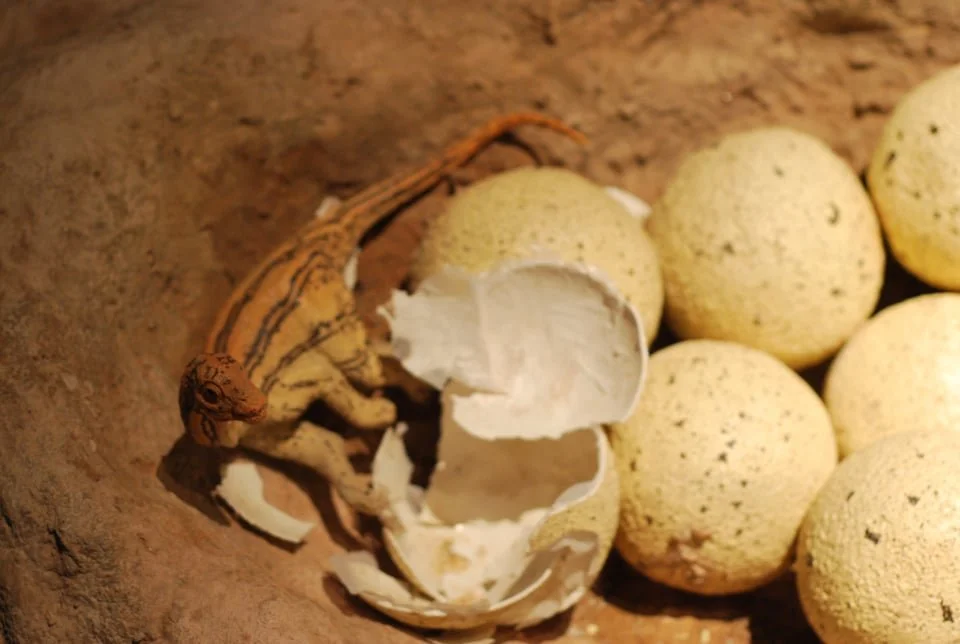
Titanosaur nests were mostly likely covered with rotting vegetation, despite this very cute model, to help keep the developing babies warm. Credit: Riley Black
This article originally appeared in Riley’s newsletter The Boneyard. To support independent science writing and get stories like this direct to your inbox, subscribe on Buttondown.
The giants were practically as far south on the continent as it was possible to be without falling off.
At the waving tip of the island continent, South America circa 70 million years ago, long necked-dinosaurs browsed the temperate forests. The summers were comfortably humid, not much different from the lush conditions that had spawned so many enormous reptiles like them through eon after eon. But the reptiles’ ability to withstand the cool and comparatively dark winters set them apart from other titanosaurs. Many of the giants chased the warmer bands of Earth’s ecosystems. The southern herbivores coped just fine with the cool.
The nature of their nests kept their babies warm. Each egg was roughly grapefruit-size, many, many, many times smaller than the adults that deposited them into carefully-dug nests. Sitting on the nest wasn’t an option. Decaying leaves and plant matter had to do, the heat of decomposition providing some stability even on the days the sun didn’t shine.
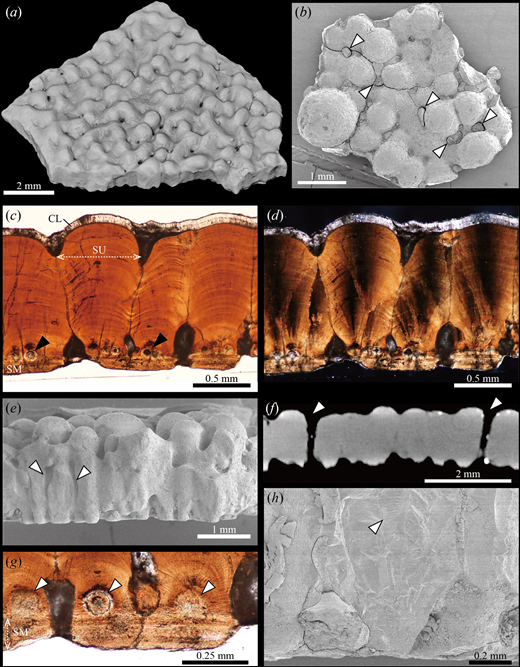
Views of Fusioolithus eggs from southern Patagonia. A represents the egg shards found there, views like c and d showing the internal, microscopic structure of the shell. From Tanaka et al. 2026
Fossil eggshell reveal the presence of the titanosaurs. Categorized as Fusioolithus by paleontologists Kohei Tanaka, Darla Zelenitsky, and colleagues, the anatomy and porosity of the eggs are most consistent with eggs laid by the enormous, long-necked titanosaurs of the Late Cretaceous. Back when these eggs were laid, in the Maastrichtian, the dinosaurs were wandering habitats at 55–60◦ S latitude. Even then, when the continents were not yet in their present position, the eggs were nestled into the ground in the southernmost portion of South America, not very far from the Antarctic Circle.
Dinosaur eggs need adults to lay them, of course, and the existence of nests hint that the adults were living in the area for a significant part of the year, at least. (Evidence of seasonal migration in non-avian dinosaurs has yet to be found.) Local conditions were suitable enough for the dinosaurs to court, mate, and nest there. Which makes South America’s sauropods different from others alive at the end of the Age of Dinosaurs.
Cretaceous sauropods of South America were found across the continent’s span. And yet, during the same slice of geologic time, sauropods in North America did not edge up against the Arctic Circle. Perhaps this is because of the group’s virtual disappearance from North America in the middle of the Cretaceous. Alamosaurus, circa 68 million years ago, represented a return of the giants to the continent. If the Cretaceous kept going, maybe there would have been a new burst of sauropod evolution. But an asteroid cut off such possibilities, creating the impression that somehow South America was especially suited to the dinosaurs whereas northern continents were much more limiting. The pattern has been taken as a hint that sauropods may have been more sensitive to colder temperatures than other dinosaurs, perhaps indicating that they were more ecothermic than the theropods and ornithischians.
I doubt there’s a single reason sauropods thrived to high latitudes in the south but didn’t do so in the north. The position of the continents in the Jurassic, competition from horned and shovel-beaked dinosaurs in the Cretaceous, and different needs in terms of vegetation, precipitation, and temperature all likely had their roles to play. Perhaps sauropods simply had more time in ancient South America to remain relatively undisturbed, to adapt and evolve to temperatures and seasonalities across the latitudes in a way that pressures on other continents didn’t allow.
What we can say, thanks to the fragments of shell, is that titanosaurs were there at the tip of South America, through days when twilight and night spread out over more than 14 hours. It was a different place than the hot floodplains favored by other giants. It was still a place with enough, enough for some of the largest animals of all time to cover up vulnerable eggs under blankets of rotting plants. Even if more limited in their range than other dinosaurs, sauropods still filled the planet’s landmasses for an incredible span of time. I wonder what where they’d be now, if a space rock hadn’t so rudely interrupted.