The "Cheetah" Fond of Fish
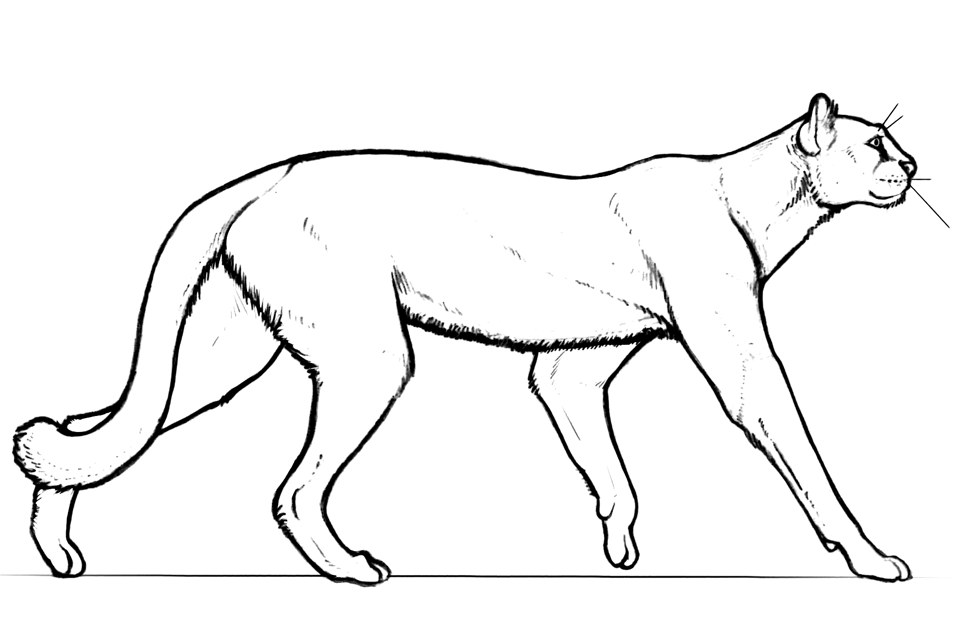
Miracinonyx was a lanky mountain lion, not an Ice Age cheetah. Credit: NPGallery
This article originally appeared in Riley’s newsletter The Boneyard. To support independent science writing and get stories like this direct to your inbox, subscribe on Buttondown.
Miracinonyx wasn’t an American cheetah.
We’ve known this for a long time. The 19th century naturalists who first noticed and described Miracinonyx considered the cat to be a slender puma. The 1977 description of a new species, then “Felis” trumani, maintained the connection. It was only the 1979 paper that established the cat’s genus, Miracinonyx, that proposed that the carnivore was North America’s cheetah.
The image stuck fast. Even as paleontologists rejected the new taxonomy and broadly considered Miracinonyx to be closer to pumas than cheetahs, the cat’s proportions seemed strange. The cat simply looked fast. Pronghorn researcher John Byers consolidated the image even further by suggesting that the incredible speed of today’s pronghorn is a “ghost” - the herbivores got their speed from outrunning the cheetah-like cats that went extinct only a few thousand years ago.
I just couldn’t buy it. Especially not when Miracinonyx kept turning up in places that didn’t make sense for a dedicated speedster of the Ice Age’s open grasslands. For one thing, the cat kept turning up in places like Natural Trap Cave in Wyoming and the Grand Canyon in Arizona - steep locales better suited to cats of the crags like cougars and snow leopards than cursorial cheetahs.
The Miracinonyx-pronghorn connection was a just-so story. It would have made sense, if not for the contradictions. Testing behavioral hypotheses regarding extinct animals, though, is very difficult. The drama of a cat chasing horned herbivores across the western American grasslands was too tempting to ignore. It was even romantic. Even after all this time, pronghorn run from a predator they once held a relationship with. It was easy to want it to be true.
A 2023 study on Miracinonyx diet didn’t clarify the situation much. The cats found within Natural Trap Cave surely ate pronghorn, but so did wolves and other large carnivores found there. The geochemical signals in the bone hinted that pronghorn were an important prey species for Miracinonyx, but that’s all. The results didn’t underscore whether the cat chased down adults, preyed on young pronghorn during the spring of each year, or provide much insight into the relationship between the animals.
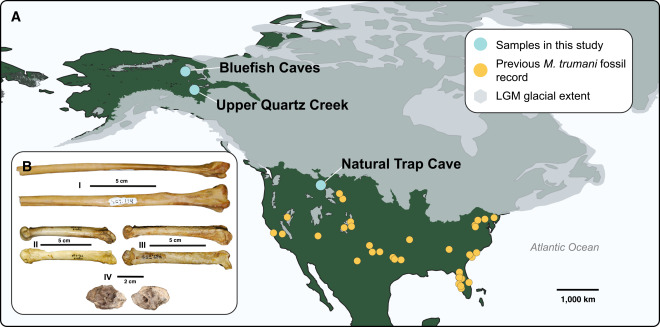
Image showing locations where Miracinonyx has been found, including in the Yukon. Credit: Cassatt-Johnstone et al. 2026
Miracinonyx fossils found in the Yukon, in the northernmost part of their range, may finally resolve the debate.
The Yukon fossils are not complete skeletons. They’re individual bones, but from cats that lived about 30,000 years ago. That’s recent enough that their DNA could be extracted and analyzed, as well as geochemical isotopes related to what the cats were eating. And these cats loved fish.
Paleontologists usually get an idea of who was eating what by how carbon and nitrogen isotopes cluster. Animals with similar diets will come out closer together. The Yukon Miracinonyx didn’t come out near their cousins from Wyoming. While the Wyoming Miracinonyx were generalist carnivores like the bears and American lion of their time, the Yukon Miracinonyx had extremely high nitrogen isotope levels - a hint that these cats had a fondness for fish like salmon.
Miracinonyx was a flexible cat. In open steppe habitats populated by many large herbivores, the cat hunted like a modern cougar. In the ancient Yukon, rich in fish, the cats took advantage of the abundance and dined on egg-filled fish far less likely to kick them in the face or gore them with a horn. Such flexibility is key to why Miracinonyx fossils are found from high latitudes down to Florida, remains scattered from the Southeast to La Brea in LA.
I’m sure Miracinonyx chased pronghorn sometimes. Cats surely can run, even if it’s not over a distance. But the new findings decouple Miracinonyx from pronghorn. There was no great evolutionary arms race between them, one predator ever-chasing a specific herbivore until the day the last died. The question now becomes how such a flexible cat perished while others, such as mountain lions and jaguars, managed to make the pivot to the Holocene.
I wish I could have seen one, lazing in the Pleistocene caring not one spot for what I think of its evolutionary history.