Tyrant's Tooth Reveals Cretaceous Face Bite
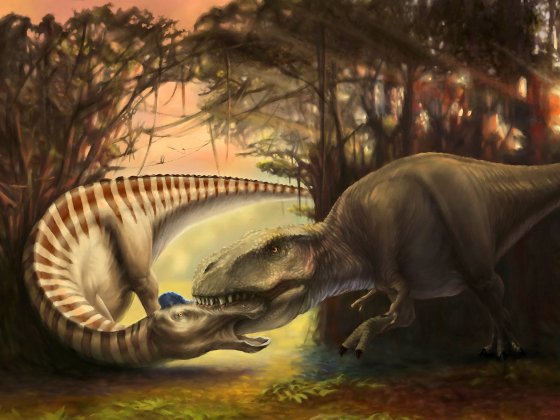
“The Bite” by artist Jen Hall
This post originally appeared in Riley’s newsletter The Boneyard. To support independent science writing and get stories like this direct to your inbox, subscribe on Buttondown.
The fossil had been on display for years. MOR 1627, the shovel-beaked skull of an Edmontosaurus found in 2005 among Montana’s Hell Creek Formation, was a gorgeous addition to the exhibit hall of Bozeman’s Museum of the Rockies. Not only was the skull near complete, but it contained the fossil of an even more iconic dinosaur. Stuck in the snout of MOR 1627 was the serrated tip of a carnivorous dinosaur’s tooth - perhaps left behind by a ravenousTyrannosaurus.
Paleontologists love fossils like these. Bitten bones immediately bring up that favorite topic loved by experts and the public alike - feeding - and often invoke the famous carnivorous of every time and age. Who did the tooth really belong to? Was the carnivore hunting or scavenging? Could the skull’s isolation mean the rest of the body was eaten? It’s an immediate invitation to come up with hazy scenarios of enormous reptiles tussling among ancient wetlands, biting and honking and stamping.
It would be easy to leave the questions hanging and say that we’ll never know for sure. Often, experts point out that it’s very difficult to distinguish between possible predation, feeding, and scavenging. But the wonderful and strange thing is that we can know a great deal about how bones were bitten and who was doing the biting. Study after study has begun to reveal how carnivorous dinosaurs put their jaws to work and the sorts of traces they left behind. MOR 1627 is the latest subject of this paleo detective work, a fossil that records a moment that must have happened often but is rarely recorded in bone.
Running a Bite Backwards
Taia Wyenberg-Henzler was curious about the tooth stuck right into the hadrosaur’s schnoz. A paleontologist at the University of Alberta, Wyenberg-Henzler was set to study tooth traces on hadrosaur skulls for a doctoral thesis and MOR 1627 certainly fit the bill. After contacting Museum of the Rockies paleontologist John Scanella, Wyenberg-Henzler says, “We got to talking about the specimen and wondering about the identity and the size of the theropod the tooth belonged to,” made easier by the fact that skull had already been CT scanned during prior study.
From our point of mammalian bias, with all of our distinctive teeth, it might seem easy to tell what dinosaur left the tooth in the snout of MOR 1647. Even though different theropods lived in the Hell Creek Formation, only a few were large enough to leave a tooth tip of such size. T. rex, as always, was the favorite. But as a 2018 study of theropod teeth pointed out, carnivorous dinosaurs all fed in a similar “puncture pull” fashion which has led many teeth to roughly resemble each other. The identity of the biter couldn’t just be taken as T. rex, especially since we’ve just seen the resurrection of Nanotyrannus.
“Even though we had a pretty good idea of what kind of theropod left the embedded tooth, we decided to take a very methodical approach,” Wyenberg-Henzler says, partly to set a standard for such analyses in the future. So far, Wyenberg-Henzler says, most of what we know about embedded teeth and toothmarks comes from individual or small scale case studies. Picking out larger patterns of how carnivorous dinosaurs fed through over space and through time will rely on assembling a broader collection of such instances. “I believe that we, as researchers, should be conducting case studies like this one to carefully document new or unusual behaviors and then combining that information together so that we can try and paint as comprehensive a picture of these extinct ecosystems as possible.”
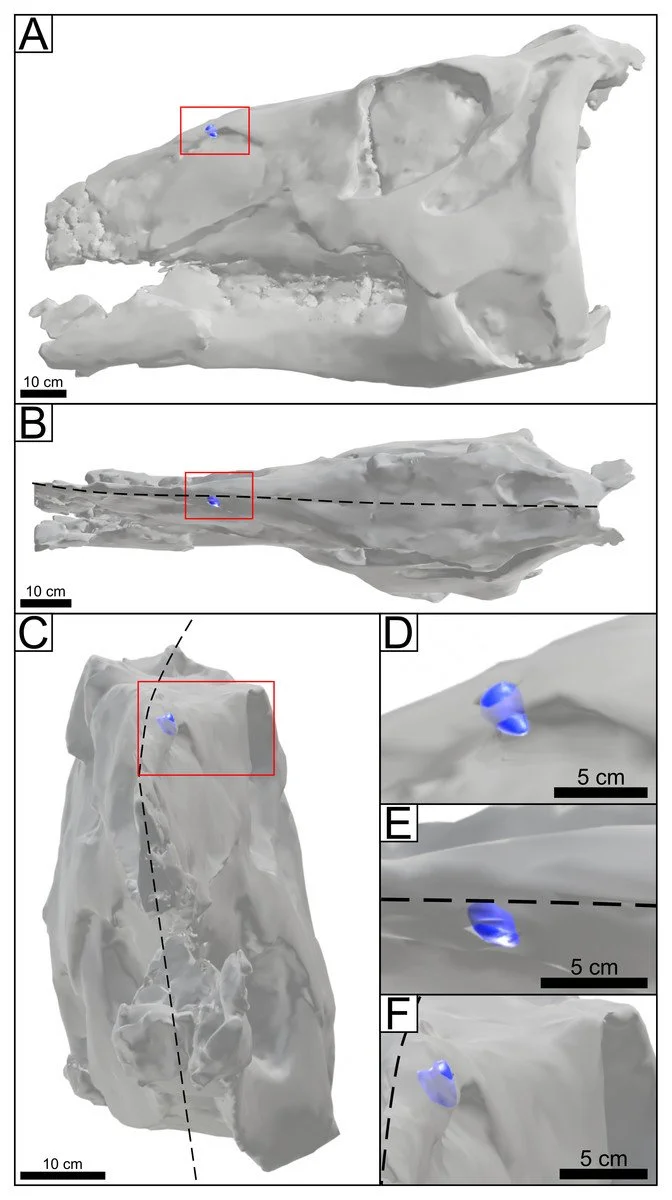
Views of the MOR 1627 CT scan, showing the embedded teeth in blue. From Wyenberg-Henzler and Scannella, 2026.
Wyenberg-Henzler and Scannella have now published their results. The dinosaur that bit MOR 1627? A Tyrannosaurus, confirmed by the dimensions of the tooth and details of the denticles that make up the tooth’s serrations. The carnivore had bitten hard enough to break a tooth in the hadrosaur’s nose, and more subtle bite marks on MOR 1627 better fit feeding than manipulation or carrying. But the researchers were able to go a step even further, to the moment so much dinosaur media loves to envision.
“I was actually surprised that we had enough information to make a convincing argument for predation and subsequent feeding on the Edmontosaurus,” Wyenberg-Henzler says. The placement and orientation of the tooth indicate a bite from the front, directly, toothmarks dotting the snout from the same bite that left the broken tooth. Given the lack of flesh on the nose of the dinosaur, as well as it seeming more unlikely that such a hard bite would have been from manipulating the carcass, the most likely scenario is predation. A Tyrannosaurus bit the herbivore right on the face.
The attacking tyrannosaur apparently fed on the Edmontosaurus after taking it down. None of the bite marks show signs of healing, and it’s difficult to imagine a hadrosaur allowing a T. rex to bite their cheek so deeply that it left additional tooth scrapes down to the bone. And yet the skull is well-preserved despite its rough treatment. Perhaps, Wyenberg-Henzler and Scannella propose, the tyrannosaur fed on more muscular parts of the hadrosaur but ultimately abandoned the carcass for one reason or another, and other carnivores were not interested. The skull’s ancient bone texture shows some areas of weathering, or exposure to the air and sun for some time after death but before burial, which hints that there was still some musculature and skin on MOR 1627 holding it together until it could be covered in sediment.
The hunting method is different from what paleontologists have previously envisioned for T. rex. Toothmarks and broken teeth have been reported from Edmontosaurus tail bones before, suggesting that T. rex liked to ambush from behind - not unlike how great white sharks surprise unaware seals. But this tyrannosaur faced the Edmontosaurus head-on, either trying to deliver a killing bite or manipulate that herbivore so that it wouldn’t escape. Either way, the additional scrapes on the Cretaceous bones tell us that the tyrannosaur was successful.
“To have a skull that preserves evidence that the animal had likely been killed and then eaten, and then be able to say that it was a tyrannosaurid that killed it, is exceptionally rare,” Wyenberg-Henzler says. The evidence has been there for years. It just took someone to look carefully and think through the behavior of animals that have been dead for more than 66 million years. In a field where we must always keep caveats in mind and be ready for hypotheses to be undone, it’s still a joy when the Mesozoic haze clears a little more and we can get a good look at those terrible teeth in action.