Tyrannoroter, the Plant-Munching Lump
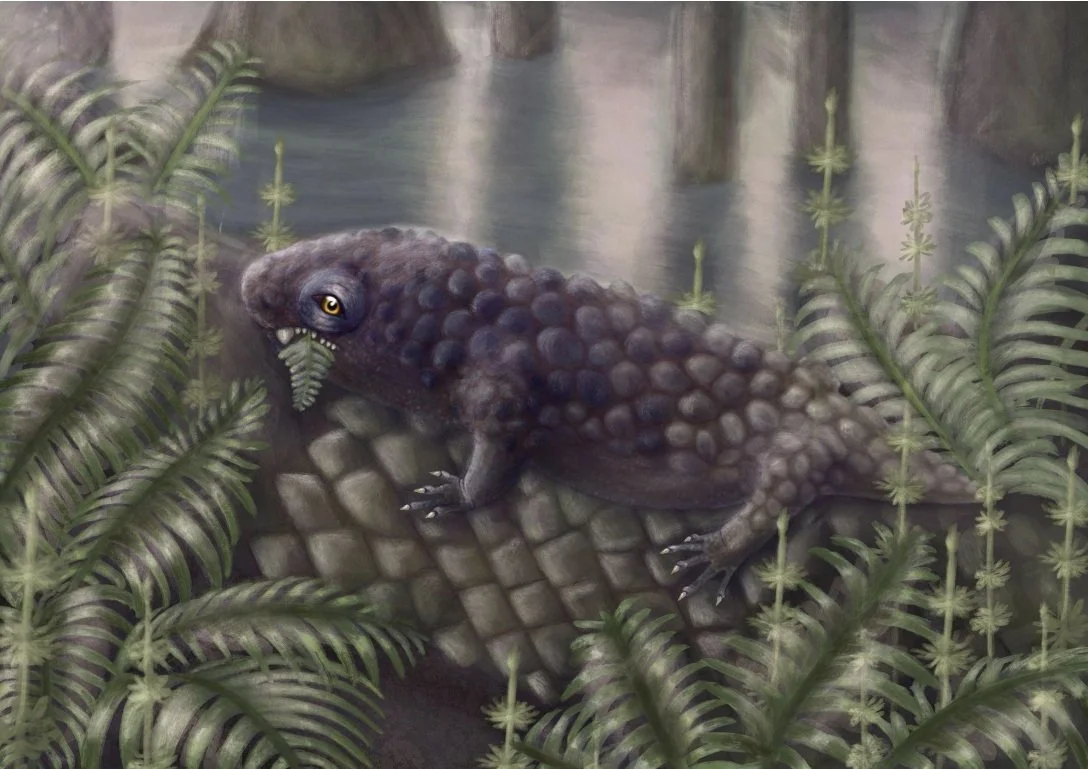
Absolutely adorable, Tyrannoroter was one of the first herbivores on land. Art by Hannah Fredd.
This post originally appeared in Riley’s newsletter The Boneyard. To support independent science writing and get stories like this direct to your inbox, subscribe on Buttondown.
I want to pet Tyrannoroter. I can’t help it. The moment news of the little creature appeared in my inbox, I wanted to cradle the Carboniferous plant-eater in my hand, stroke its scales, and tell it that it’s a very good lump.
The lovely art by Hannah Fredd, of course, required some restoration. All we know of Tyrannoroter herberti is the animal’s skull, found within the petrified walls of 307 million-year-old tree stump preserved in what’s now Nova Scotia. But the anatomy of those skull bones and teeth allowed Field Museum paleontologist Arjan Mann and colleagues to not only determine that Tyrannoroter belonged to a mysterious group of early land vertebrates called “microsaurs,” but that this adorable nipper was one of the earliest vertebrates to start feeding on plants.
We don’t have a good, common term for what Tyrannoroter is. The fossil dates from the time of vast, green coal swamps, habitats thriving with arthropods, early amphibians, and a slew of tetrapods that were becoming terrestrial in their own unique ways. The new animal is a “microsaur,” the quotes signaling paleontological suspicion that various animals placed into this group of reptile-like vertebrates are actually members of a broader array of groups. They just haven’t been all described and sorted out yet. Still, the resemblance of Tyrannoroter to other “microsaurs” immediately stood out. “As soon as I saw the skull, even in its unprepared form, I exclaimed how pantylid-like the features were, such as the heart skull shape,” Mann says.
The teeth of Tyrannoroter stood out, too. Its little mouth was full of the rocky pegs, not only in the expected tooth rows but clustered in a battery of rounded, pulverizing teeth on the palate. What’s more, revealed through CT scans, the teeth were worn by shearing and grinding. Experts have seen such traits before. Lots of stubby teeth, worn by grinding, point towards repeat trips to the Carboniferous salad bar.
In it for the crunch
Eating plants is difficult to do. Even among modern animals, for example, herbivores require bacterial assistants in their guts to break down cellulose. Otherwise the nutrition plants contain can’t be released. And plants are hard on teeth. The tough and abrasive parts of plants that allow them to grow tall, withstand harsh weather, and otherwise come in so many shapes can wear down enamel as surely as chewing a bone can grind a way the tooth of a carnivore. So paleontologists expected that early tetrapods that were beginning to spend more and more time on land would have taken a long time to spin off herbivorous forms, munching fish, insects, and other tetrapods offering easier ways to feed. But the fossil record has undercut the idea that tetrapods delayed working plants into their diets. Tyrannoroter, as well as a sail-backed protomammal Mann and colleagues described in 2023 called Melanedaphodon, indicate that microsaurs and other tetrapods started feeding on plants at the same time as other major evolutionary shifts, like the origin of the amniotic egg, were also allowing vertebrates to spend more time out of the water.
“The environment Tyrannoroter lived in was a dense, mangrove-like swamp,” Mann says. Green, tree-sized lycopods reached high into the air and scaly-looking trees rose from wet lowlands dotted with stumps and fallen logs. It was our planet, filled with organisms that still have relatives alive today, but in varied, archaic forms with names like temnospondyls, aistopods, myriapods, and more. The world had never seen forests like these before. For hungry animals capable of breaking down plants, perhaps taking in bacteria that had evolved to break down plant tissues in the process, the world was overflowing with food.
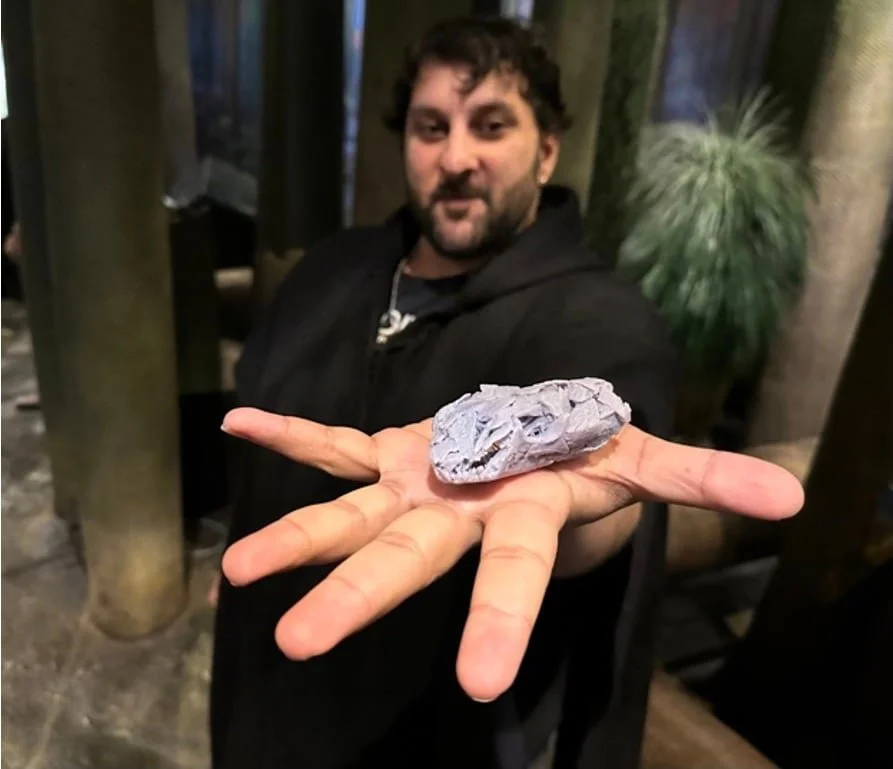
Paleontologist Arjan Mann holding a 3D print of the Tyrannoroter skull. Credit: Field Museum
Mann’s work on both Melanedaphodon and Tyrannoroter leave no doubt that herbivores were an important part of the big evolutionary burst as Carboniferous tetrapods spread between water, shore, and land. “It is likely that herbivory was experimented on as early as the first terrestrial tetrapods arose,” Mann says, four-legged vertebrates walking into a world full of new possibilities. Some of the herbivores, such as plant-eating protomammals, managed to stick around and flourish. Others, like sweet little Tyrannoroter and other microsaurs, disappeared by about 270 million years ago. “In this adaptive radiation, it is likely there were many forays,” Mann says, “some successful, some not. That’s evolution!”
So what, then, about the name? Tyrannoroter is an unusual title for a stubby plant-eater about the size of a football. I wondered if other names had been considered, but Mann confirmed that Tyrannoroter was the only choice. The largest microsaur known from its fossil layers, “Tyranno” felt right for a prefix and the hypothesized burrowing habits of related species added the “roter,” with the species named in honor of Nova Scotia fossil hunter Brian Herbert. Three informational beats neatly wrapped in a title. But, forgive me, I’ll always appreciate the irony. Tyrannoroter, the terrible digger, small enough to be held in my arms as the creature thinks of juicy ferns and horsetails that break with a crisp snap. I love it.
Since this piece was written, one of its coauthors, Hans Dieter-Sues, passed away. I only knew Hans from brief interactions at SVP and museums, but he was always kind and encouraging. I will miss him.