Early Ichthyosaurs Had Big Litters
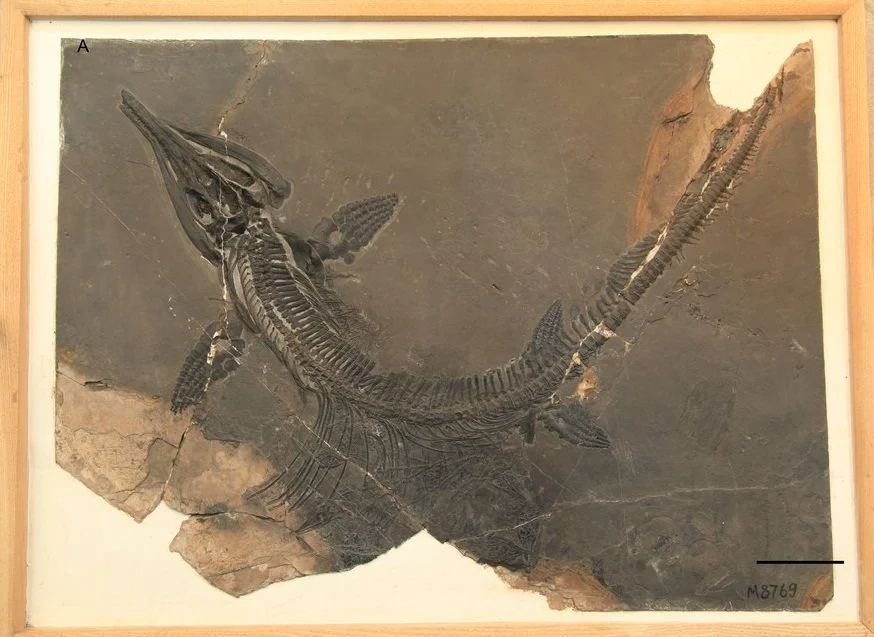
This gravid Mixosaurus was preserved with the bones of at least eleven babies. Credit: Gu et al. 2026
“fetuses 7 to 11 may have been scattered by gas explosion after death.”
There’s no way to be sure. There’s no indication of what killed the swollen-bellied Mixosaurus in the first place. It’s the positions of fetuses 7 to 11, the arrangement of the tiny strings of vertebrae and splint-like ribs, that hint at the familiar chain of events. The fish lizard perished, filled tight with decomposition gases in the following days, and bust shortly before the whole family was buried under a blanket of ocean debris that locked the entire scene into limestone more than 245 million years ago.
Paleontologists had found Mixosaurus with embryos inside before. In 1996, paleontologist Winand Brinkman described a Mixosaurus skeleton with at least three fetuses. Compared to ichthyosaur fetus associations found much earlier in human history, and representing other times in the Mesozoic, that first Mixosaurus indicated that ichthyosaurs evolved live birth very early in their history - if they hadn’t already inherited the ability from a shore-dwelling ancestor. But no one had ever found eleven fetuses in an early ichthyosaur before, an exceptional number that may underscore the appetite of other reptiles swimming the same Triassic seas.
The little bones do not represent a last meal. The remains are demonstrably tiny, developing ichthyosaurs that do not show any signs of acid-etching or digestion. There are no fish scales or squid hooks among them to indicate that they were in the stomach rather than the uterus. Mixosaurus had impressive litters, paleontologist Shengxiao Gu and colleagues conclude. And ancient waters brimming with an expanding array of predatory reptiles was good reason to squeeze out as many little swimmers as possible at a time.
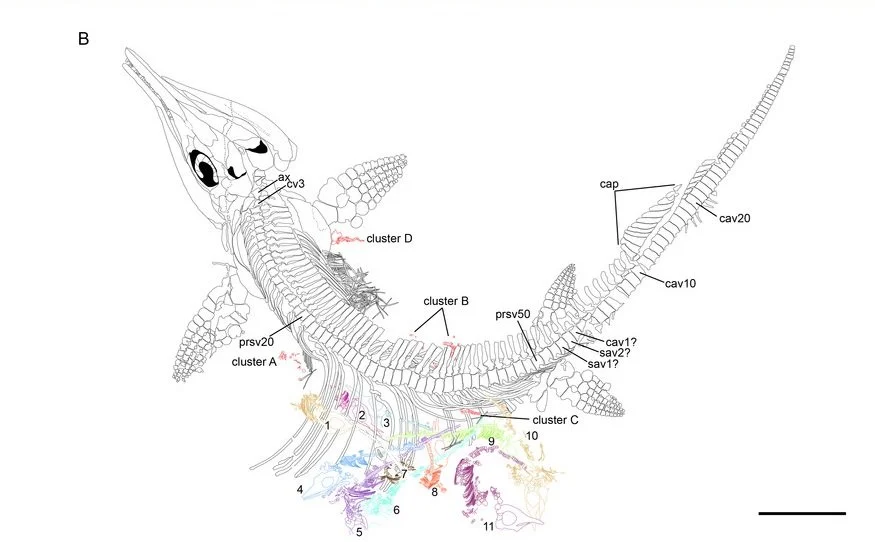
A diagram showing the location - 1 to 11 - of the fetuses found with the adult Mixosaurus. Credit: Gu et al. 2026
The earliest ichthyosaurs paleontologists have uncovered so far were small, almost eel-like swimmers that lived in the shallows about 246 million years ago. These earliest ichthyosaurs may represent a radiation that was already well underway. In rocks 244 million years old, barely younger than the earliest ichthyosaurs, paleontologists have uncovered immense, whale-sized ichthyosaurs that grinned with zipper jaws of pointed teeth. Once ichthyosaurs started swimming, they filled the seas rapidly and with an ever-expanding array of forms.
The fish lizards weren’t alone. Early Triassic waters were also home to the long-necked pistosaurs (forerunners of plesiosaurs), crocodile-like phytosaurs, ridiculous tanystropheids, enigmatic thalattosaurs, and more. Some of these Triassic forms were predatory, toothy animals that could have easily munched on little ichthyosaurs. Others, like the muppet-like hupehsuchians, had bone armor, suggesting there were creatures in the water that bone armor would protect against. Ichthyosaurs did not evolve such physical defenses, though. If the gravid Mixosaurus is any indication, early ichthyosaurs had larger litters so that some might survive long enough to start the cycle all over again.
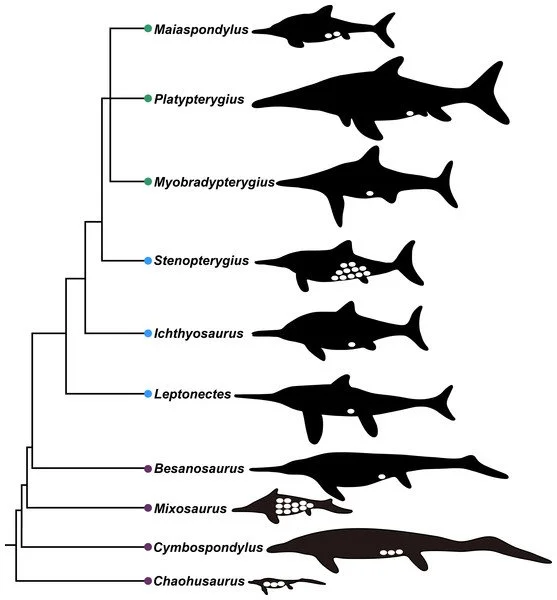
Many ichthyosaur fossils have been found with embryos inside, but it’s unclear whether ichthyosaurs could vary between large and small litters. Credit: Gu et al 2026.
Gu and colleagues propose that Mixosaurus was likely r-selected. That’s a generalized label for organisms that have large numbers of offspring but provide little rearing or parental care. Think sea turtles or sauropod dinosaurs. Then again, the earliest report of Mixosaurus embryos only found three, which more closely resembles what experts have found among later ichthyosaurs. What could explain the difference?
Preservation plays a role, of course. Perhaps the earlier Mixosaurus carried more offspring but those were not buried and folded in to the fossil record. Maybe they weren’t covered up or were pushed away from the site of fossilization by gas explosion. Then again, maybe ichthyosaurs evolved the ability to bear small or large litters as the situation warranted. A specimen of the much later Jurassic ichthyosaur, Stenopterygius, has also been found with eleven embryos when most gravid Stenopterygius have one, two, or three fetuses inside. The taphonomic histories of these specimens are essential to untangling whether these fossils represent the full complement of developing babies or only preserve a few, but it’s possible that part of the reason ichthyosaurs were so successful for so long is that they were able to shift between small and large litter sizes as environmental conditions changed.
The Mixosaurus embryos don’t seem to have any consistent orientation in relation to their parent’s skeleton. Then again, the hypothesized gas explosion might have mixed things up a bit. But if it didn’t really matter whether the babies entered the water head- or tail-first, it’s another point of comparison for experts. Perhaps birth orientation becomes more locked in with size, or Mixosaurus was so early in ichthyosaur history that the selective pressures to favor one or the other birth direction hadn’t arisen yet. (Previous studies have suggested that birth orientation has less to do with habitat than other physical factors in the life of the parent ichthyosaur.)
It’s not a neat and clean conclusion, not the sort of reveal that makes a standard science story. But that’s why I like it. Maybe ichthyosaurs were variable, flexible reptiles, able to respond to the changing Mesozoic seas in ways that we’re only just beginning to see. Tragic as each individual fossil of this kind is, they still tell us something about ancient life that would otherwise remain invisible. One ending lets us imagine so many other beginnings.