Flowers For Dinosaurs
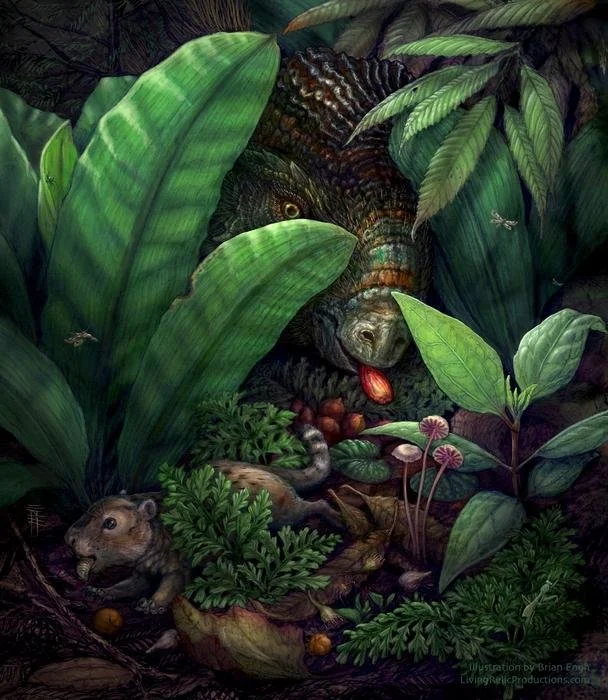
Fossils from the Cretaceous of New Mexico indicate that forests rife with flowering plants were common millions of years earlier than previously thought. Credit: Brian Engh, livingrelicproductions.com
It’s fun being wrong sometimes.
When I wrote When the Earth Was Green, dense forests lush with angiosperms were thought to be a Cenozoic phenomenon. Paleobotanists hypothesized that pre-impact forests were relatively open with dinosaur-size gaps between stands of looming trunks, aggregations of trees and low-growing plants boasting an abundance of redwoods, monkey puzzle trees, ginkgoes, ferns, cycads, bennetitales, and other ancient plants. Palms, dogwoods, laurels, and other angiosperms were around by then, but were shouldered to the side by the steadfast gymnosperms and their relatives. It was the impact 66 million years ago that not only nourished the soils but inadvertently razed Earth back to seed, angiosperms out-growing other forms of plant life as soon as the catastrophe abated.
The picture seemed clear, and made sense as a change tied to a big ecological shakeup. Jurassic Park-style forests thick with palms and trees festooned with fruit did not exist in the time of T. rex, to the point I wrote a Smithsonian article about it. But now I’ve happily come to learn that the view from the Mesozoic has shifted. Forests full of fruit-producing angiosperms existed 75 million years ago, and likely much earlier than that.
The key fossils were buried in ash about 74.6 million years ago in what’s now New Mexico, more specifically found within the Jose Creek Formation. Over a hundred miles from the edge of the Western Interior Seaway, stumps, leaves, fruit, flowers, and seeds were rapidly covered over in little flecks of ash that encapsulated the botanical remains at the same time mosasaurs were swimming over ancient Kansas. Now uncovered and assessed by paleontologists, the fossils representing the forest community don’t resemble previous expectations of Late Cretaceous forests. The most abundant plant fossils in the Jose Creek sample are angiosperms, from the stumps of magnolia and palm trees to dozens of different seed types made by flowering plants. And the seeds are big for their age. The average seed size in the sample is comparable to a blueberry, and the largest seeds in the sample are bigger than lima beans.
Together, paleontologist Jaemin Lee and colleagues report, the botanical collection indicates an unexpected forest. The angiosperm seeds found at the site are more abundant, more diverse, and come in a broader range of sizes than those from any other known Cretaceous site. Some of the seeds even come from trees that formed their fruit nearer the canopy than the ground floor. Angiosperms were not on the ecological margins but were critical parts of the Cretaceous forest. Such a collection was essential to recognizing this point, Lee and colleagues note, because of how the fossil record is studied and brought into collections. Large Cretaceous angiosperm seeds had previously been reported from other fossil sites, Lee and colleagues note, but it seems no dedicated collections were made. Many important Cretaceous plant fossils went straight from the field into private collections, as well, and so the importance of the botanical remains was hidden. “Systematic field collection efforts and the digitization of existing records are essential to refining our understanding,” Lee and colleagues write.
Naturally, the Jose Creek fossils don’t just document how angiosperms flowered through evolutionary time. The variety of seed types outlines the different ways those seeds were spread and the ways in which Cretaceous forests grew together. The plants show signs of their relationships, both with the elements and the animals that lived among the prehistoric woodlands.
The word Lee and colleagues use most often in their study isn’t “seed.” It’s diaspore. This, technically speaking, is the seed and its surrounding soft tissues. The soft tissues often tell us how the seed is meant to be transported away from its parent tree.
Some of the diaspores from the New Mexico site have small wings on them like those you might seen enclosing maple seeds. The seeds were moved by wind. But far more common in the sample are seeds surrounded by fleshy tissue, fruit or one form or another. These are diaspores that were meant to attract animals and be eaten, seeds transported through an animal’s guts and deposited with a gift of dung somewhere else. Plants that rely on animals to spread their seeds were thought to be rare until after the K/Pg catastrophe, and yet an abundance of them grew millions of years before T. rex and Triceratops even existed.
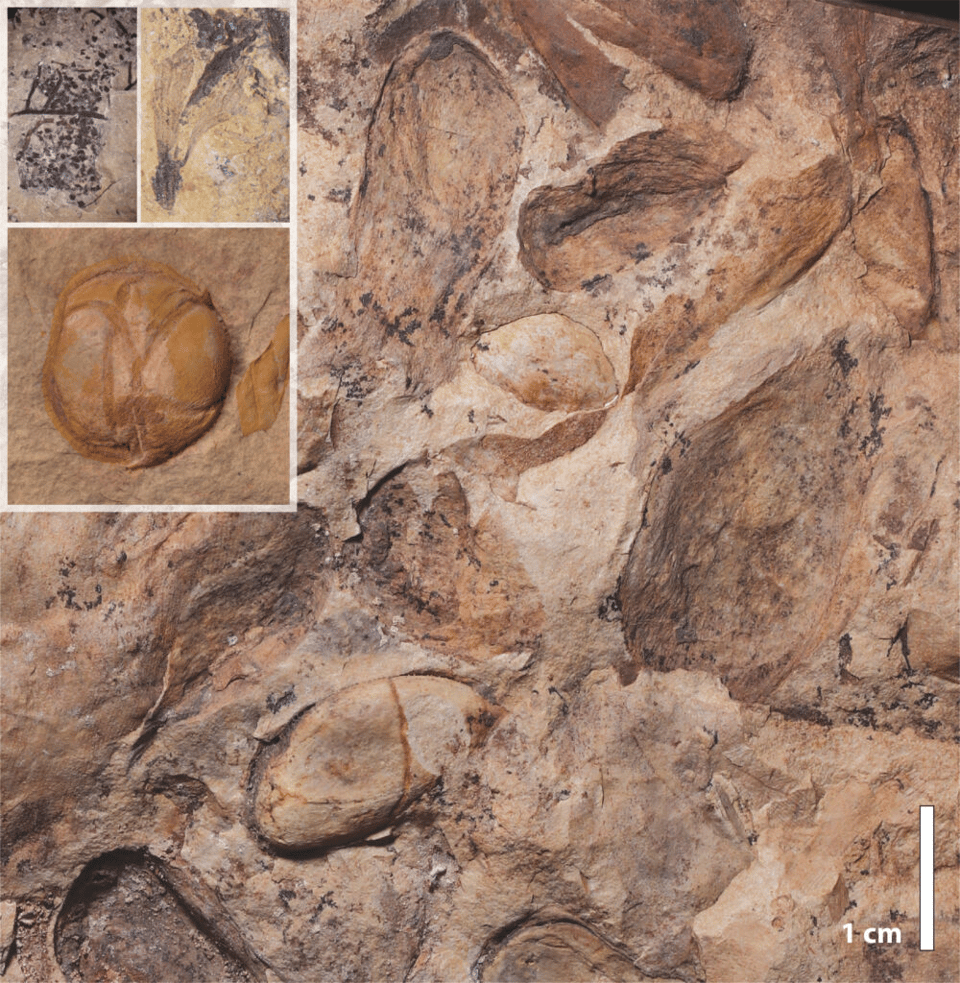
Seeds from the Jose Creek Formation, small seeds to the left and larger diaspores to the right. Credit: Cindy Looy and Jaemin Lee/UC Berkeley
Pieced together from the various diaspores, leaves, and other fossils, Lee and coauthors envision the Jose Creek forest had a closed canopy. It still wasn’t like a modern, multi-tiered rainforest. Conifers were still the primary trees to form canopies at the time, opening high but not creating the layers that modern angiosperms do. So it was with the Jose Creek forest, a few angiosperms growing high as others sprouted lower down to dangle fleshy fruit for small animals. It was a forest unlike any that we know now, a humid and tropical place where a tangle of fruiting plants huddled below the shade of palms and conifers. I can practically hear the rustle of a few multituberculates shuffling and hopping among the dropped fruit of an angiosperm, softly rustling in the sun-dappled shade only to scatter with the thumping approach of a small ornithopod dinosaur. The dinosaur scoops two and three diaspores into its beaky mouth at time, whatever doesn’t get crushed in its jaws coming to rest safely within the little reptile until the intact seeds can make a hopeful exit elsewhere in the Cretaceous world.
What other undiscovered forests might be out there?