One Good Croc Feeds Another
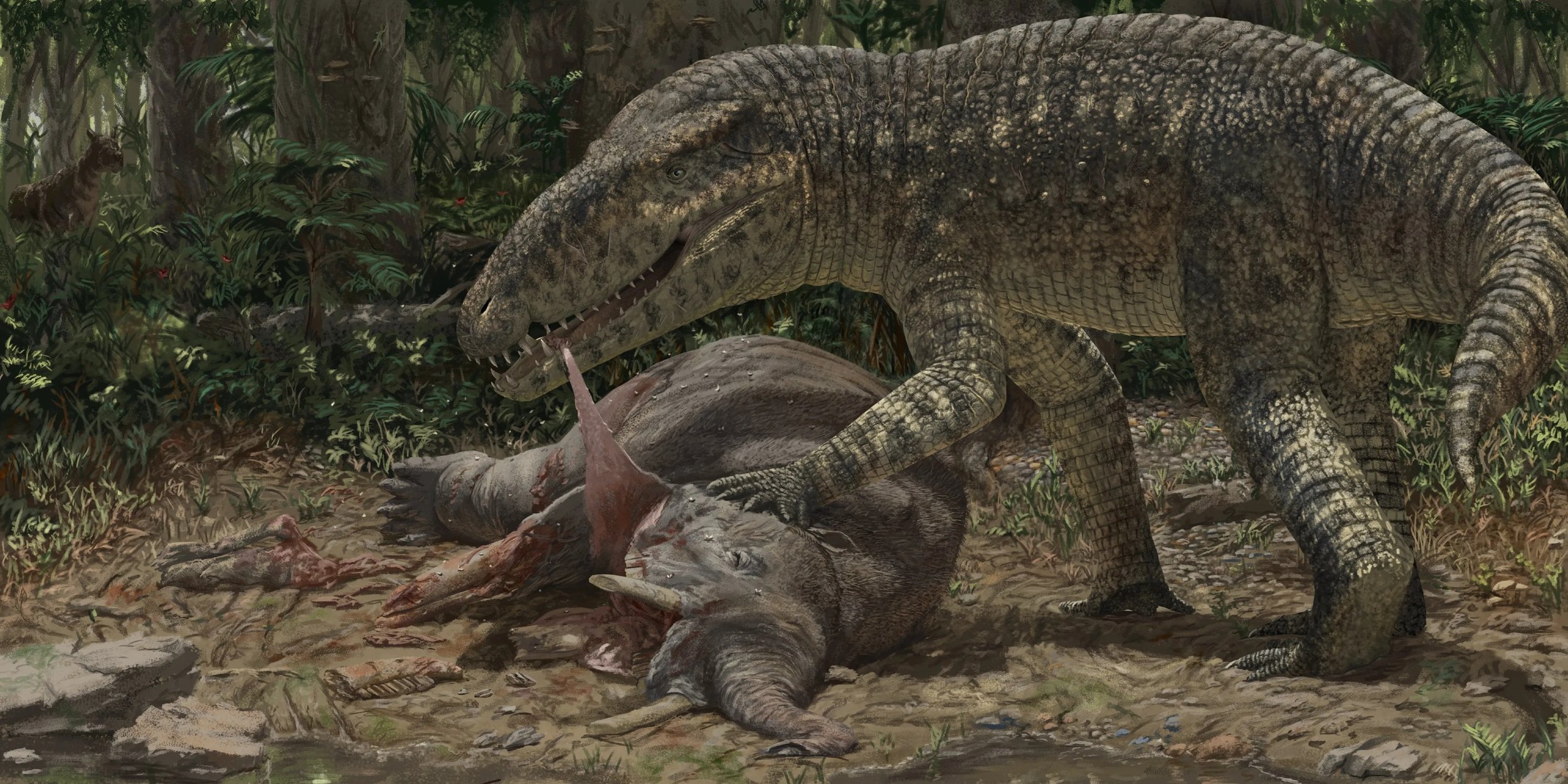
In a Miocene swamp, the crocodile Langstonia scavenges the elephant-like Xenastrapotherium. Credit: Miguel Hernandez
This article originally appeared in Riley’s newsletter The Boneyard. To support independent science writing and get stories like this direct to your inbox, subscribe on Buttondown.
The swamp water isn’t safe.
What waited beneath the weed-clogged surface was no mystery. Singly or in huddles, immense crocodiles regularly bask beneath the Miocene sun. Their broad armored backs soak up the warmth, hanging open their cavernous mouths when it gets too warm. It’s hard to miss the yawn of a 30-foot-long caiman.
But the most threatening crocs of all were the ones that went unseen. There’s so much water here. Silty rivers flow by mucky ponds and other variations of mud, plant, and water that make any trip through the wetlands a navigational challenge. There’s not just enough water to hide one immense crocodile. There’s enough to hide entire populations of multiple species, to say nothing of the few knife-toothed reptiles that charge out of ambush through the trees.
Xenastrapotherium had been vigilant. The snouty mammal had trotted through the waterlogged groves for years, the elephantine tusks jutting from their jaws a testament to how long the herbivore had survived. But care is sometimes subsumed under bad luck. One cool evening, the low sun obscured the subtle movement just below the surface of the water, what the mammal intended as another wary drink at the water’s edge turned into a gift for massive crocodylian jaws - a massive Purussaurus that had just recently found itself hungry again.
The mammal was big, equivalent to a black rhino of the Holocene, but the reptile was far bigger. And the jaw strength of a saurian that size cannot be argued with. With a grip, a toss, and a cheek-tooth crunch, all the meat and bones that mammal had grown through the years were quickly prepared to nourish the caiman.
But crocs can be distractable eaters. The big croc took some of the most reliably-meaty parts, around the limbs and the hips. Viscera exposed through the busted body cavity was a suitable second course. But much of the rest, along the ribs and spine and skull, was more crunch than delectable bite. After a couple days the Purussaurus moved on to other business, keeping an eye on the shaggy and plump Pericotoxodon splashing around between swaths of forested land.
Several days have passed since then, birds and insects taking small bites from what’s left. Exposed to the air, the stink didn’t take long to entice Langstonia to saunter up to the decaying beast.
The reptile doesn’t often get to feed on this particular mammal. To catch such herbivores, the terrestrial croc has to adequately time a sprint from the undergrowth. The window to catch a mammal before they’ve got their feet under them is very small, and many can outrun Langstonia after more than a few moments. But Purussaurus had already done the hard work for its relative, and there’s plenty enough still to peel away.
The rear of the mammal’s head, housing thick jaw-closing muscles, have remained largely untouched. The croc’s blade-like teeth readily scrape away the soft tissue from the mammals skull and jaws, pulling back as much as can be gleaned from the carcass. Big as they could get, Purussaurus could afford to fill themselves and wait a while. Life on land moves faster. The blood of Langstonia pulses warm as the croc ambles beneath the shady canopies and trots exposed along the forest edge. What the other crocs leave behind, the blade tooth eagerly polishes off.
The Miocene is supposed to be deep into the Age of Mammals. Beasts, the broad narrative goes, proliferated and took over our planet after a huge asteroid dismissed the non-avian dinosaurs and other reptiles 66 million years ago. But the fossils of Colombia’s La Venta Formation demonstrate how there has never been a true Age of Reptiles or an Age of Mammals - only an ever-shifting relationship between the prolific vertebrates.
The fossil fauna of La Venta, paleontologist Oscar Wilson and colleagues note, contains far more large crocs than you’d expect. At least nine species coexisted among the Miocene wetlands around 12 million years ago, from terrestrial forms like Langstonia to the massive ambush predator Purussaurus. The crocs were the primary carnivores in this place, a landscape where meat-eating mammals were rare and herbivorous beasts were nabbed by the waterside. We know from the bite marks.
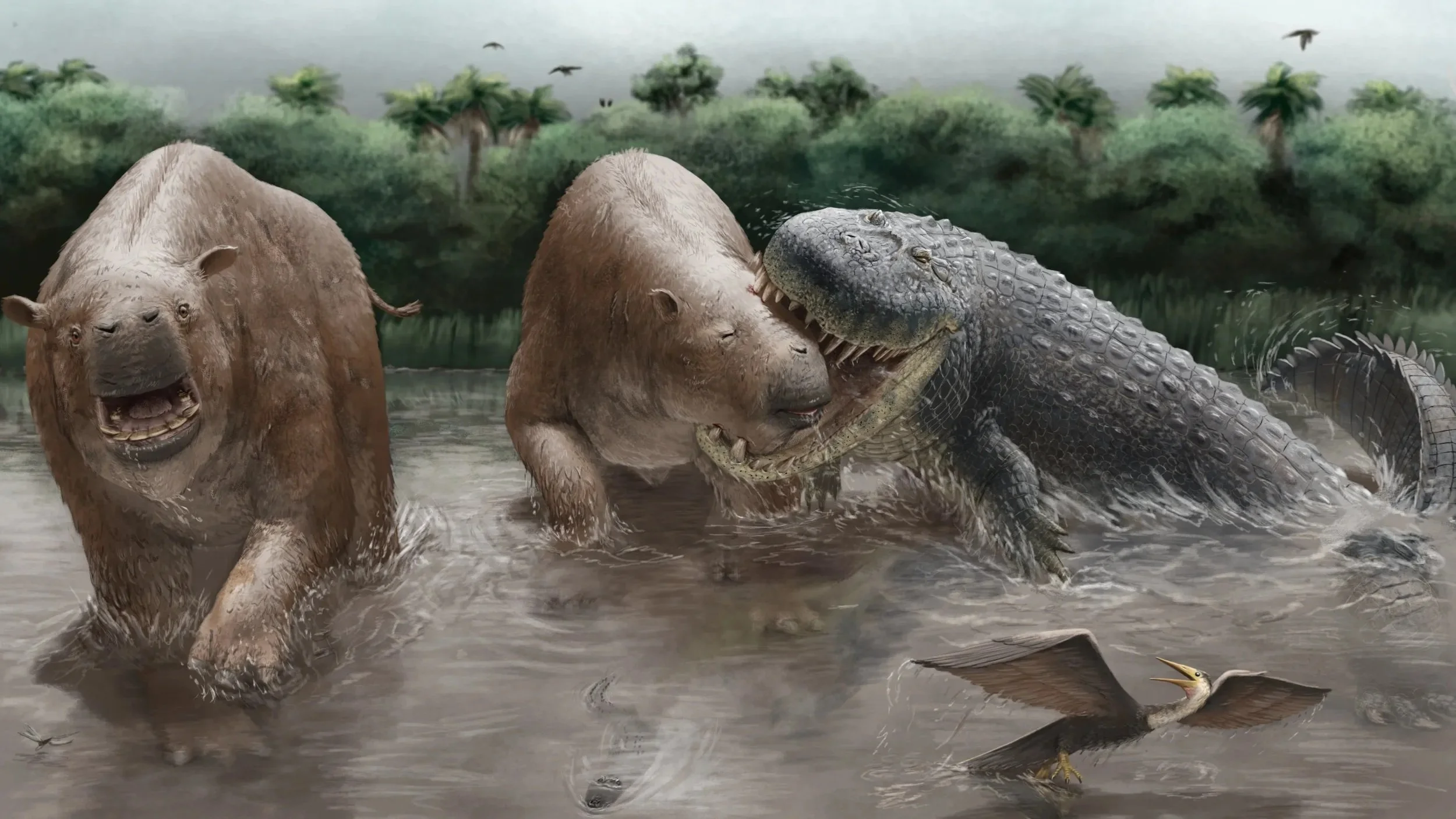
An unwary Pericotoxodon is nabbed by Purussaurus. Credit: Miguel Hernandez
Wilson and coauthors catalog an expanded set of these bite marks in a new Journal of Vertebrate Paleontology paper. Most of them were round punctures left by Purussaurus, a broad-headed caiman relative that was among the largest crocs of all time. The fact that many of the bitten mammals bear punctures on the face and snout hint that these punctures are signs of predation, Purussaurus targeting vulnerable points that would incapacitate or at least painfully grip the prey. And, within the collection, fossils of the elephant analog Xenastrapotherium show bite marks that can be attributed to two local crocs - punctures from the Purussaurus that likely killed the mammal, and additional toothmarks from a tiger-sized terrestrial croc like Langstonia.
The abundance of Purussaurus bite marks, their locations on the mammal fossils, and the possible scavenging traces offer an outline of how the La Venta ecosystem worked in the Miocene. Large crocodylians were the primary predators, particularly Purussaurus. But like modern crocs, it’s likely that these large reptiles often left behind carcasses with significant amounts of soft tissue and bone still on them. These partial remains would have offered an abundant source of food for various other organisms, including other crocs, creating a habitat where reptile predators and mammalian prey molded each other much more directly than environments elsewhere in the world at the same time. A place where the lost days of the Mesozoic felt much closer.