Teeth in the Shallows - "Lucy's Peril"
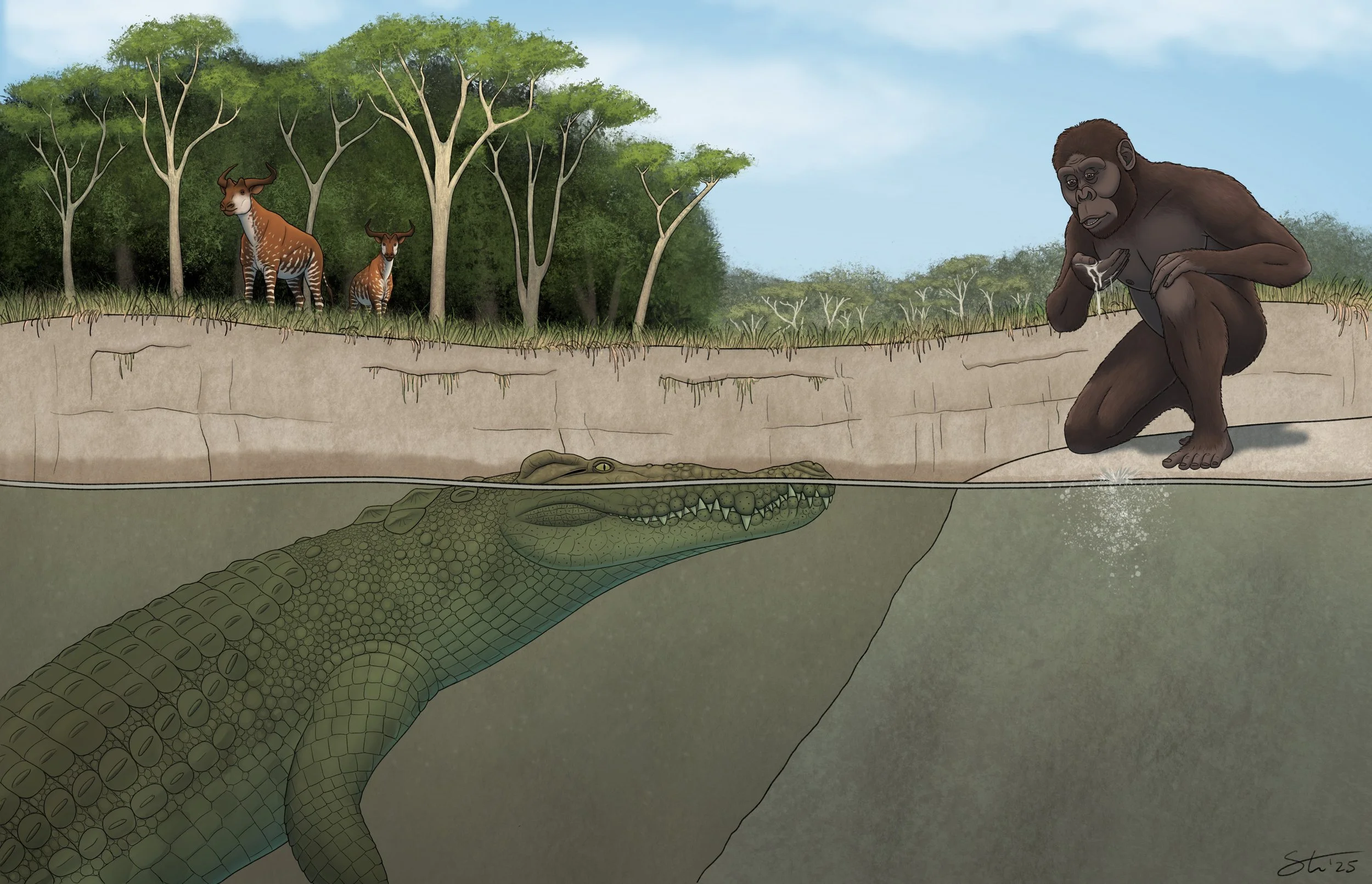
How many australopithecines were eaten by crocodiles? The world may never know. Credit: Tyler Stone/University of Iowa
This post originally appeared in Riley’s newsletter The Boneyard. To support independent science writing and get stories like this direct to your inbox, subscribe on Buttondown.
We have predators to thank for the human fossil record. Truly. Whether it’s the Homo erectus cracked open and collected by ancient hyenas among the caves of Zhoukoudian or the eagle eye scratches left in the iconic Taung Skull, carnivores often dragged ancient humans - perhaps literally kicking and screaming - into environments where those hominin remains came to rest. A few bite marks and cracked epiphyses are a small price to pay for knowing more about what our relatives and ancestors were doing way back when.
Sometimes we know the predators responsible. The giant, burly Pachycrocuta of Zhoukoudian were buried with their table scraps. Other times, we can only guess from damage left on bones. How fortunate, then, that paleontologist Stephanie Drumheller and colleagues just recently introduced us to the very impressive croc that would have given Lucy’s species, Australopithecus afarensis, reason to watch the water’s edge carefully.
Described earlier this year by Chris Brochu, Drumheller, and colleagues, Crocodylus lucivenator is the only crocodile yet known from the famous Hadar, Ethiopia fossil sites where Lucy’s species was first found. It was a big reptile. Multiple fossils of C. lucivenator indicate that the croc was more than 12 feet long and weighed more than 600 pounds. The australopithecines that wandered the same environment over 3 million years ago were snack size by comparison, around four feet tall and a hundred pounds.
I’m not going to hold you in suspense. So far, we don’t have direct evidence of C. lucivenator chomping away on an australopithecine. We’re not likely to find the horror-ready scenario of early hominin bones wrapped up inside the ribcage of a fossil croc. Then again, when Brochu and coauthors named C. anthropophagus from the geologically younger layers of Oldupai Gorge, the researchers picked the name because of crocodile bite marks sometimes found on the bones of early humans Homo habilis and Paranthropus boisei uncovered in the area. Given that the newly-named C. lucivenator is the only crocodile found in the Hadar beds - whereas other fossil sites have up to four croc species - any conical-tooth bite marks found on Hadar’s A. afarensis would have probably been made by the big croc.
Of course, crocodile species still inhabit eastern Africa today. And some prey on people. In 2018, a crocodile bit and killed a pastor performing baptisms in Ethiopia’s Lake Abaya. But it would be a mistake to paint C. lucivenator with a Nile crocodile brush. “Lucy’s peril” was something more ancient, part of a cluster of ancient crocodiles that dwelt among the rivers and lakes of eastern Africa before the ancestors of today’s Nile crocodiles arrived.
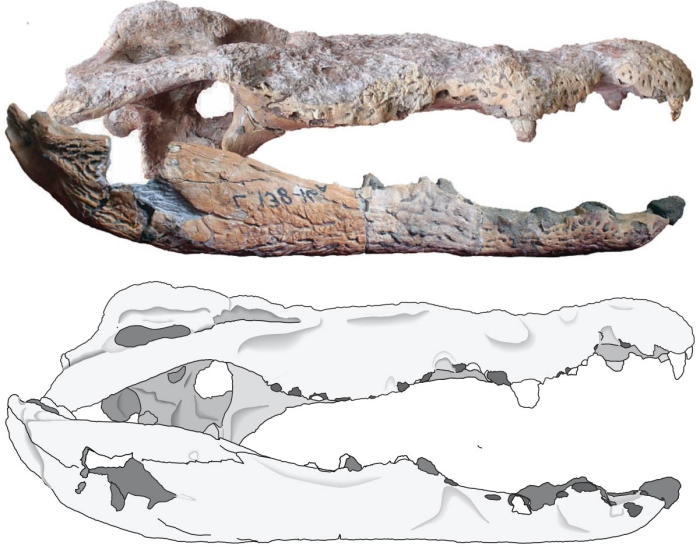
The skull of C. lucivenator. Credit: Christopher Brochu/University of Iowa
You might miss the telltale signs if you’re not intimately-acquainted with croc anatomy. C. lucivenator had a bump in the middle of its snout, similar to that of today’s American crocodile but not Nile crocs. The snout of C. lucivenator is proportionally longer, as well, another trait that links it with C. anthropophagus and other fossil species found in Tanzania and Kenya. The ambush predators represent a long-lived profusion of what the paper terms Paleoafrican crocs that were watching early humans from the lakeshore, the ancestors of the region’s modern crocs, the Neoafrican crocs, arriving in the area around 200,000 years ago.
The new study notes that experts are still working out the big picture of Crocodylus evolution - something that seems to have kicked off in Africa before crocodiles dispersed to other continents before newer species returned to overlap with and replace the older Crocodylus groups - but the complexity is another nail in the coffin for the idea that modern crocs have just stayed the same, evolving in place, for hundreds of millions of years. Modern crocodiles fill the niches of their ancient counterparts, but only because the modern crocs returned to the place where their Miocene and Pliocene ancestors first emerged.
I wonder what the humans who saw Crocodylus lucivenator thought of it. If the reptile’s presence made them favor some water sources over others. If they had nightmares, like I sometimes do, of flashing teeth and then darkness. If they poked at dried skeletons out on sandbars and riverbanks, finally able to see this thing that’s so menacing when alive. I wonder.