Stunning Serpent Reveals Secret of Snake Successs
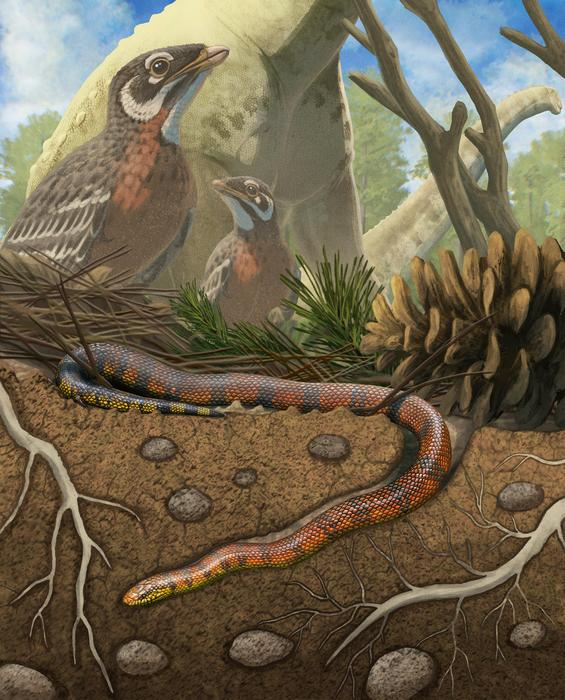
The ancient snake Tametara mirim burrowing below the feet of huge dinosaurs - and hungry birds. Credit: Gabriel Ugueto
This article originally appeared in Riley’s newsletter The Boneyard. To support independent science writing and get stories like this direct to your inbox, subscribe on Buttondown.
“There’s a snake in the driveway!”
I had been waiting all summer for this. I’d seen sadly-squashed little garter snakes near my home for months, but never a living noodle. I hoped they’d find my block a relative refuge, especially for being a little shaggier than the manicured lawns nearby, but weeks and weeks went by without sight of so much as a scaly tail disappearing into the undergrowth. But sure enough, last week, a little garter snake froze and eyed me suspiciously from the driveway, just a small thing that slid right into the weeds the moment I took a few steps back. It was just a joy to see them, and I hope their belly remains full.
Of course it makes intuitive sense that snakes are lizards, sans limbs. There are many lizards that have lost one or both pairs of legs and evolved a similar elongated shape, slowworms and skinks and worm lizards and more, but it’s snakes that most enthusiastically adopted the legless life. In the seas, the forests canopy, and in the soil itself, snakes have been spinning off an amazing array of species since the Jurassic.
But how did the snake story start? Paleontologists have been hung up on this mystery for decades. Perhaps burrowing made the difference. If the earliest snakes nuzzled their way through the ground, then legs would have been in the way and held them back. Then again, other experts propose that the change from lizard to snake occurred in the water. Sideways undulations might have benefited from a more streamlined body than one with legs causing extra drag.
The problem with these arguments is that one ecological setting is often favored over another, as if an animal occupies only one type of habitat. It’s useful for framing an argument, but biology is far messier than any hypothetical evolutionary scenario can account for. Precision is near impossible. The best we can hope for is that we get close enough to something that clears some of the fog and provides us a few more clues. And in the case of our serpent friends, a new study suggests that early snake evolution was molded in a broad range of ecologies rather than a distinct and constrained environmental setting.
The secret to early snake flexibility is found in their fossil skulls.
Earlier this summer, paleontologist Tiago R. Simões and colleagues described a new species of Cretaceous snake from the roughtly 80 million-year-old rocks of Brazil’s Bauru Basin. Named Tametara mirim, the fossil is absolutely stunning - a near-complete fossil serpent preserved in three dimensions. The last part is critical. Uncrushed, the fossil better preserves internal details like the shape of the brain, inner ear, and cranial nerves. Simões and colleagues could look at the biological wiring related to how the snake was living.
The neuroanatomy of Tametara didn’t exactly match that of any living snake. That’s intuitive. The snake slithered around back when non-avian theropods the size of a school bus were running around. But the visible traits are most consistent with a burrowing lifestyle, suggesting that this slender snake was shoveling soil out of the way with its nose as it slid beneath the ground.
But Simões and colleagues didn’t just look at Tametara. The experts looked at the brain of another early snake, Dinilysia patagonica found in rocks of the roughly the same age in Argentina. It’s the second of only three known early snakes with uncrushed skulls (the other being Sanajeh from India), and therefore critical for comparison with Tametara. Despite living at about the same time, however, Dinilysia had a very different brain shape from Tametara. The second snake’s brain seemed attuned to life on the surface of the ground, slithering over it like my driveway garter snake.
Neither Dinilysia nor Tametara are the earliest snakes known. Right now, the oldest snakes date back to about the middle of the Jurassic, over 165 million years ago. No one knows exactly what kind of habitats they preferred to live in, and, as yet, no one has found comparable skull material to run the same kinds of tests. Snakes had been diversifying for more than 80 million years by time Tametara was shoving its way through the earth. Still, the significant differences between Tametara and Dinilysia hint that early snakes took up an array of behaviors in different ecological settings - a burst of diversification in natural history as well as species. Crown snakes - that is, the group that contains all modern snakes going back to their last common ancestor - emerged from this variety.
We’ll need more fossils to unravel the puzzle. It’s just the nature of paleontology. Find one fossil and you find yourself in need of at least a dozen more to answer all the new questions. But now paleontologists can set their gaze on a broader range of habitats, look for unexpected snakes that might further contradict what we previously thought. Snakes will not reveal their secrets easily.